Trang chủ UXMagic
  • Tính năng
  • Thư viện
  • Cộng đồng
  • Bảng giá
  • Tiếp thị liên kết
  • Tài nguyên
Trang chủ UXMagic
Trang chủ UXMagic

Thư viện

Cộng đồng
Bảng giá
Tiếp thị liên kết

Tài nguyên

Theo dõi chúng tôi trên:
  • Theo dõi chúng tôi trên Slack
  • Theo dõi chúng tôi trên Twitter
  • Theo dõi chúng tôi trên Linkedin
  • Theo dõi chúng tôi trên Youtube
  • Theo dõi chúng tôi trên Instagram
Tất cả bài viết

Why Consistency Beats Creativity in SaaS UI

Đăng ngày
Mar 18, 2026
A
Bởi
Adarsh Kumar
Thời gian đọc
7 mins read
Why Consistency Beats Creativity in SaaS UI
Chia sẻ bài viết này

Trong trang này

Chia sẻ bài viết này

Your product isn’t slow because of engineering.

It’s slow because your UI is a mess.

Not visually but structurally. Different button styles across modules. Three versions of the same dropdown. Engineers debating spacing tokens instead of shipping features.

And the worst part? You probably called it “creative exploration.”

Here’s the uncomfortable truth: In SaaS, creativity in core UI isn’t a strength. It’s a liability.

The Hidden Cost of Design Debt in SaaS Scaling

Design inconsistency doesn’t just look messy—it compounds into operational damage.

The “Frankenstein” UI Problem

When teams don’t enforce component governance, this happens:

  • The same dropdown gets rebuilt 4 times
  • Engineers argue over spacing instead of logic
  • CSS overrides pile up
  • No one trusts the design system anymore

This isn’t hypothetical.

Mid-market SaaS teams lose ~$1.5M/year to design debt—purely from redundant work and engineering friction.

And it gets worse as you scale.

The Real Impact on Product Metrics

Inconsistent UI directly leads to:

  • Higher cognitive load → slower onboarding
  • Confusion across modules → support ticket spikes
  • Broken flows → lower feature adoption
  • Friction → increased churn

You’re not just shipping slower. You’re actively making your product harder to use.

Jakob’s Law: Why UI Creativity is a Liability

Designers love originality. Users don’t.

Jakob’s Law is simple: Users expect your product to work like every other product they already use.

The Usability Failure of “Innovative” Navigation Systems

Let’s call this out clearly:

  • Centered logos that break navigation expectations
  • Scrolljacking for “wow factor”
  • Reinvented layouts for standard flows

This isn’t innovation. It’s friction.

Even small deviations can cause massive usability drops. Example: changing logo placement can increase navigation failure rates 6x.

Predictability > Delight

In B2B SaaS:

  • Users don’t want to be impressed
  • They want to finish tasks fast

“Delight” is a vanity metric.

Predictability is the real KPI.

If users notice your UI, you’ve already lost.

Overcoming “Context Amnesia” in AI UI Generation

AI-generated UI looks impressive—until you try to use it.

The Problem: Stateless Generation

Typical AI tools:

  • Forget layout structure after 2–3 screens
  • Change colors mid-flow
  • Drop navigation components randomly
  • Break typography systems

This is called context amnesia.

And it makes AI output unusable for production.

Flow Mode vs. Static Screen Generation

This is where tools like UXMagic actually matter.

Instead of generating isolated screens, UXMagic’s Flow Mode:

  • Locks layout anchors (navbars, headers, grids)
  • Maintains token consistency across screens
  • Prevents structural drift entirely

So instead of “pretty images,” you get:

  • Connected flows
  • Stable architecture
  • Production-ready structure

If you’ve struggled with multi-screen AI outputs, this is the difference between demo and deploy.

The Logic-First Developer Handoff Workflow

If your process still starts with pixels, you’re doing it wrong.

Here’s what actually works.

Phase 1: System Architecture (Before Design)

You don’t design screens. You define constraints.

  1. Semantic Tokenization

  • Replace hex values with tokens (e.g., color.primary.action)
  • Enables global consistency and instant updates

  1. Component Governance

  • Define all components upfront
  • Include every state (hover, error, disabled)
  • Lock spacing to a grid system

  1. “Frankenstein” Audit

  • Identify duplicate components
  • Deprecate everything inconsistent
  • Force a single source of truth

This is where most teams fail because it’s not “fun.” But it’s where scalability actually comes from.

Phase 2: Logic-First Generation (During Design)

Now you assemble not create.

  1. Text-to-Structure Planning

Define flows like:

  • Dashboard → Select Record → Edit Modal → Save

No visuals yet. Just logic.

  1. Component Assembly via AI

Use AI to:

  • Assemble layouts from predefined components
  • Enforce tokens automatically
  • Prevent rogue styles

This is where UXMagic’s component assembly model fits naturally, it doesn’t “draw UI,” it builds it.

  1. Multi-Screen Consistency

  • Lock layout anchors
  • Maintain state across screens
  • Eliminate drift

If you’re still generating screen-by-screen, you’re creating future bugs.

  1. Progressive Validation

Validate in layers:

  • Flow logic
  • Layout structure
  • Visual polish

Not the other way around.

Phase 3: Automated Handoff (After Design)

Your final output shouldn’t be a Figma file.

It should be structured, validated, and ready to ship.

  1. Token Linting

  • Detect rogue styles
  • Replace with approved tokens automatically

(If you want to go deeper here, this connects directly to how design systems workflows actually scale in production.)

  1. Visual Regression Testing

  • Catch UI drift in CI/CD
  • Prevent silent breakages

  1. DOM-Aware Export

  • Output React/HTML—not images
  • Remove ambiguity in handoff

This is how you eliminate the “verification tax” engineers complain about.

The industry keeps telling you to be more creative.

That’s exactly why most SaaS products break at scale. The teams that win aren’t the most original. They’re the most consistent.

So the real question is:

Are you designing for Dribbble or for deployment?

Stop Designing Screens. Start Building Systems.

If your team is still fixing inconsistencies after design, you’re already too late.
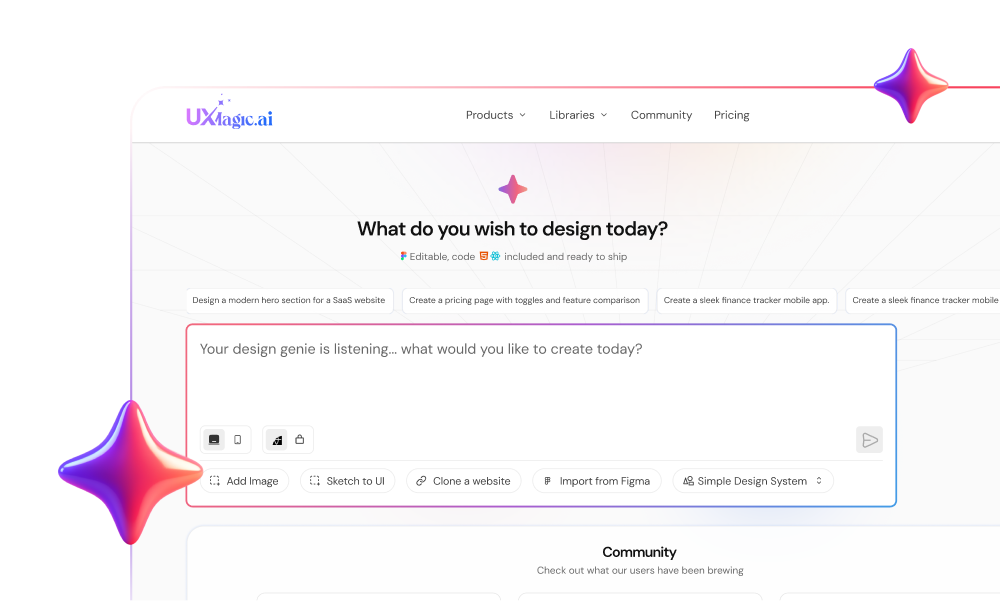
Try UXMagic for Free
UXMagic
Faq

có thắc mắc?chúng tôi có câu trả lời.

Consistency reduces cognitive load by aligning with user expectations. This leads to faster onboarding, fewer errors, and higher feature adoption.

Design debt costs mid-market SaaS companies around $1.5M annually, consuming up to 40% of engineering time on rework and inconsistencies.

It dictates that users expect familiar patterns. Deviating from standard layouts increases friction, slows task completion, and hurts usability.

It’s when AI forgets layout and style rules across multiple screens, resulting in inconsistent and unusable UI flows.

By using token-based constraints, component libraries, and automated linting to ensure outputs follow strict system rules.

Bài viết liên quan
Real Prompts We Use to Generate Product Flows
Cập nhật ngày
Mar 9 2026
Bởi Samyuktha JS
11 min read
How to Clone a Website with AI
Cập nhật ngày
Jul 17 2026
Bởi Sakshi Soni
11 mins read
Image to Figma Converter: 9 Free & AI Tools Compared (2026)
Cập nhật ngày
Jul 20 2026
Bởi Adarsh Kumar
12 mins read
Lovable Review 2026: What It's Actually Good For (and Where It Falls Short)
Cập nhật ngày
Jul 22 2026
Bởi Kushi Arikati
12 mins read
V0 by Vercel Review 2026: Features, Token Pricing, and Best Alternatives
Cập nhật ngày
Jul 24 2026
Bởi Abhishek Kumar
10 mins read
What Is a PRD? Complete Product Requirements Document Guide + Template
Cập nhật ngày
Aug 5 2026
Bởi Ajay Khatri
15 mins read
Accessibility Heuristics Checklist for UX Teams: A Practical Framework
Cập nhật ngày
Aug 6 2026
Bởi Sakshi Soni
13 mins read
Emergent AI Review 2026: Is Full-Stack Vibe Coding Production-Ready?
Cập nhật ngày
Aug 11 2026
Bởi Kushi Arikati
15 mins read
Bolt.new Pricing 2026: The Real Cost Behind the Token Model
Cập nhật ngày
Aug 12 2026
Bởi Surbhi Sinha
15 mins read
TeleportHQ Review 2026: Is Design-to-Code Production-Ready?
Cập nhật ngày
Aug 12 2026
Bởi Abhishek Kumar
14 mins read
What Is Figma AI? Every AI Feature Explained (2026)
Cập nhật ngày
Aug 13 2026
Bởi Adarsh Kumar
13 mins read
What Is Visual Hierarchy in UI Design? A Practical Guide for Product Teams
Cập nhật ngày
Aug 18 2026
Bởi Sakshi Soni
13 mins read
Subframe Review 2026: Features, Pricing, and Top Alternatives
Cập nhật ngày
Aug 25 2026
Bởi Samyuktha JS
11 mins read
UI Layout Design Principles: A Tactical Guide for Product Teams
Cập nhật ngày
Aug 14 2026
Bởi Surbhi Sinha
13 mins read
UX Design Methodologies Explained (And Which Ones Still Matter in 2026)
Cập nhật ngày
Jul 20 2026
Bởi Adarsh Kumar
15 mins read
What Is a Product Requirements Document (PRD)? A Designer’s Take
Cập nhật ngày
Apr 9 2026
Bởi Ajay Khatri
14 mins read

Tham gia cộng đồng của chúng tôi

Chia sẻ sản phẩm, tìm hỗ trợ, cập nhật tin tức và kết nối với những người dùng UXmagic.ai khác

ý tưởng tiếp theo của bạn
xứng đáng được ra đời

đừng chỉ nghĩ về nó nữa. cứ gõ ra đi. Vụng về, dang dở, sao cũng được. Chúng tôi sẽ biến nó thành điều có thật.

Sản phẩm

  • Cộng đồng
  • Các gói giá
  • Chương trình tiếp thị liên kết
  • UXMagic MCP
  • Claude MCP
  • Thông tin AI

Tài nguyên

  • Trung tâm trợ giúp
  • Thư viện Figma
  • Thư viện React
  • Mẫu ứng dụng di động
  • Tài liệu
  • Hướng dẫn

Tính năng

  • Từ câu lệnh thành UI
  • Từ hình ảnh thành UI
  • Từ bản phác thảo thành UI
  • Sao chép website
  • Nhập từ Figma
  • AI Wireframe Generator
  • AI Mockup Generator
  • AI Prototype Generator
  • AI Dashboard Generator
  • Tất cả tính năng

So sánh

  • vs UX Pilot
  • vs Relume
  • vs MagicPath
  • vs Magic Patterns
  • vs Banani
  • vs Galileo AI
  • vs v0
  • vs Lovable
  • vs Base44
  • Tất cả đối thủ

Blog

  • AI trong quy trình thiết kế UX: Điều gì thực sự hiệu quả
  • Mẫu câu lệnh cho dashboard SaaS
  • Những câu lệnh thực tế chúng tôi dùng để tạo luồng sản phẩm
  • Prompt Engineering cho UX Designer
  • Công cụ Wireframe tốt nhất năm 2026: So sánh 10 lựa chọn miễn phí & trả phí
  • Tất cả bài viết

Công ty & Hỗ trợ

  • Tuyển dụng
  • Liên hệ
  • Chính sách bảo mật
  • Điều khoản sử dụng
  • Cài đặt cookie
  • Theo dõi chúng tôi trên Slack
  • Theo dõi chúng tôi trên Twitter
  • Theo dõi chúng tôi trên Linkedin
  • Theo dõi chúng tôi trên Youtube
  • Theo dõi chúng tôi trên Instagram

© 2026 UXMagic AI Technologies Inc.