You’ve generated the “perfect” AI dashboard.
It looks sleek. It has KPI cards. A line chart. A left sidebar.
Your engineers open the file… and immediately tell you it’s unusable.
No edge states. No real data schema. No conditional logic. No respect for your design system. Just a glossy happy-path mockup that collapses the moment it meets a real backend.
That’s the execution gap.
And if you’re building serious B2B SaaS, you don’t have time for toy outputs.
The Anatomy of Production-Ready AI Design Prompts
Let’s kill a myth first.
“Prompt engineering” is not about clever wording.
It’s about specification.
Professional designers don’t write:
“Design a sleek analytics dashboard for a logistics tool.”
They write something that looks disturbingly close to a PRD.
Escaping the Generic Dashboard Trap: Advanced Prompt Structures
If you don’t define structure, AI defaults to statistical averages:
- Dark sidebar
- 4 symmetrical KPI cards
- Random line chart
- Airy spacing
- Zero hierarchy
Algorithmic homogenization at its finest.
To escape this, your prompt must define:
- Data Schema
- Explicit data types (Int, Boolean, currency)
- Character limits
- Required columns
- Density expectations
If the AI doesn’t know whether a metric is a fluctuating percentage or a binary alert flag, it cannot design hierarchy correctly.
- Structural Grid Rules
- 8pt grid
- Bento-grid layout
- Row heights (e.g., 32px for dense tables)
- Divider rules (e.g., 1px solid #E5E7EB)
This isn’t aesthetic nitpicking. It’s cognitive load control.
- Persona & Cognitive Context
Example: Senior B2B logistics manager operating under high cognitive load.
That forces:
- Tight data density
- Clear tabular lining figures
- Explicit row boundaries
- Progressive disclosure
AI does not empathize. It synthesizes constraints.
If you don’t inject them, it guesses.
Overcoming AI Context Amnesia in Complex SaaS User Flows
Multi-step onboarding is where most AI tools collapse.
You define:
- Dark-mode enterprise aesthetic
- Role-based branching logic
By screen three?
The model forgets everything. You get a bubbly light-mode consumer UI.
This is context window degradation.
The Bento-Box Prompting Framework for B2B Product Design
Stop writing long conversational prompts.
Instead, separate concerns:
role definition persona - <data_schema>
- Explicit branching logic
- Visual constraints
Then generate:
- Step 1: Decision node
- Step 2A: Admin path
- Step 2B: Analyst path
- Step 3: Unified success
You are not asking for “an onboarding flow.” You are mapping conditional branching logic.
If you want deeper examples, review complex SaaS user flow examples before prompting. The more precise your divergence logic, the less AI hallucinates.
Executing the InformationalPromptingTransparency Play
One underrated move: Force the AI to explain itself.
Add: “Output a rationale explaining why you chose this layout structure based on the provided persona.”
This forces semantic reasoning before UI rendering.
It reduces illogical layout decisions and reveals when the AI misunderstood your structural constraints.
From Prompt to Production: The Figma and React Handoff Workflow
Even if generation is perfect, handoff is where AI usually fails.
Why?
Because most outputs are:
- Flat frames
- Hardcoded hex values
- Random padding
- No real DOM hierarchy
Phase 1: Pre-Generation Discipline
Before generating anything:
- Synthesize research into structured
blocks - Define exact JSON data schemas
- Sketch macro-layout spatial relationships
- Inject design tokens and typography scale
If you skip this, you are just vibe coding with extra steps.
You can revisit advanced Figma auto-layout best practices to ensure your structural foundation won’t collapse during export.
Phase 2: Structured Generation
Use multimodal initialization.
Upload:
- Low-fidelity sketch
- Competitor screenshot
- Structural wireframe
Then map textual constraints onto defined spatial zones.
This mathematically anchors output and mitigates hallucination.
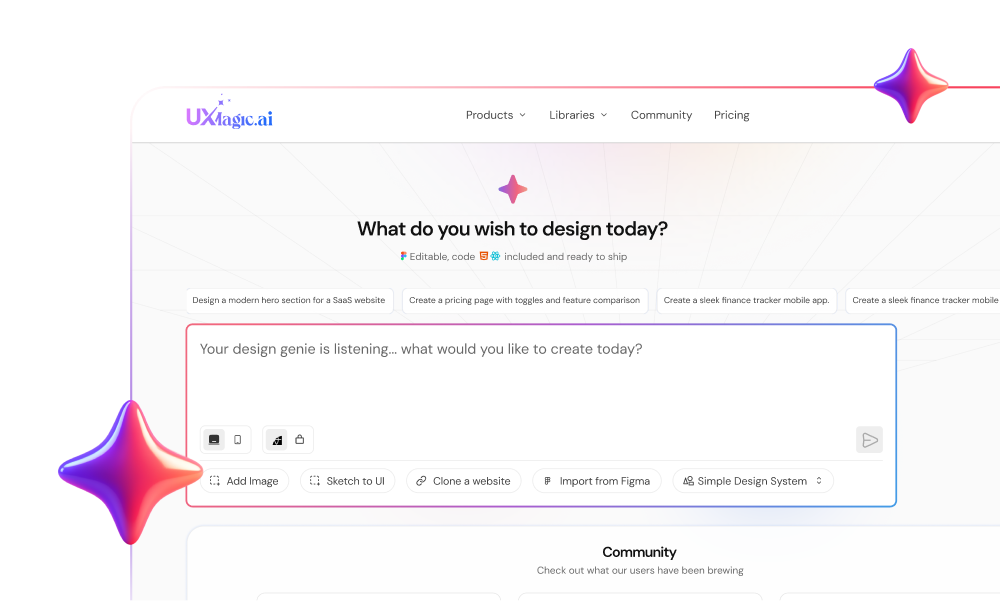
When generating multi-screen flows, use UXMagic’s Flow Mode to maintain:
- Color tokens
- Border radii
- Typography scale
- Style continuity
Flow Mode prevents the common “screen three amnesia” problem that plagues isolated generation tools.
Phase 3: Validation and Expansion
Treat AI output as a first draft.
Then:
- Audit layer structure
- Strip hallucinated spacing
- Reapply strict design tokens
- Enforce Figma auto-layout
- Inject edge states:
- 404
- 500
- Empty states
- Inline validation
- Destructive confirmations
This is where most teams fail—and where UX debt starts accumulating. If you’re modernizing legacy systems, be careful not to let AI remove required business logic in pursuit of “minimalism.”
Deterministic Code Handoff
This is the real test.
If your AI tool cannot export:
- Clean React components
- Semantic HTML
- Structured DOM hierarchies
…it’s a concept tool, not a production tool.
UXMagic bridges this execution gap by:
- Preserving structured auto-layout
- Enabling clean export into Figma
- Supporting native React/HTML/Webflow output
Instead of developers rebuilding everything from scratch, they refine.
That’s acceleration.
Ship Like an Architect, Not a Vibe Coder
If you treat AI like a creative partner, you’ll get pretty pictures.
If you treat it like a deterministic compiler with strict constraints, data schemas, structural grids, and enforced reasoning, you’ll get acceleration.
The difference is discipline.
Start writing prompts like PRDs. Anchor generation with real structure. Refine locally, not destructively. Demand code-ready output.
And if you want AI to actually respect multi-screen logic and design system integrity, try generating your next complex flow in UXMagic’s Flow Mode.
Don’t ask for a “sleek dashboard.”
Ask for something your engineers can ship.
Generate Product Flows Your Team Can Ship
Create structured UI flows with real logic, consistent design, and clean exports your developers can actually build. Design smarter with AI.