You didn’t adopt AI to slow your team down.
But here you are reviewing broken layouts, fixing padding, rewriting tokens, and wondering why your “10x faster” workflow now needs babysitting.
The worst part? The outputs look convincing. Clean dashboards. Polished UI. Until you try to extend it into a real flow and everything collapses.
This isn’t an AI problem. It’s a control problem.
AI without human direction doesn’t accelerate design. It creates invisible debt that explodes during handoff.
The Reality of AI in Design: Why Prompting is Not Enough
If you’re still trying to “prompt your way” into good UI, you’re solving the wrong problem.
AI doesn’t understand your product. It predicts pixels.
The Hidden Cost of the “Verification Tax”
You brought in AI to move faster. Instead:
- Designers spend 4.3 hours/week verifying outputs
- Fixing hallucinated components
- Re-aligning spacing and tokens
- Rebuilding logic AI skipped
That’s not acceleration. That’s overhead.
And it compounds:
- ~$14,200/year per employee
- Zero net output
- Higher risk of missed errors due to fatigue
The real danger isn’t bad output. It’s convincingly wrong output.
Context Amnesia and the Collapse of Multi-Screen Flows
AI treats every screen like a fresh start.
So:
- Your sidebar disappears on screen 2
- Typography shifts
- Layout structure breaks
- Navigation becomes inconsistent
This is context amnesia.
And if you're building real products, it’s catastrophic.
If you’re not actively preventing context amnesia in complex flows, you’re not building a system, you’re generating disconnected artboards.
Why Pure-AI Generated UI Fails in Production
Let’s be blunt.
Most AI-generated UI fails not because it looks bad—but because it’s structurally useless.
The Blind Spot for Invisible States (Error, Empty, Loading)
AI designs the “happy path.”
It ignores:
- Empty states
- Error handling
- Loading feedback
- Disabled interactions
So your UI looks complete but behaves like a static poster.
And users notice immediately.
Token Drift: When AI Breaks Developer Handoff
This is where things fall apart.
Your design system says:
- color.primary.500
AI says:
- #3A7BFF
- --brand-blue-v2
Now your:
- Figma → React mapping breaks
- CSS variables mismatch
- Engineers rewrite everything
That’s token drift.
If you’re not actively resolving CSS token drift and deterministic variable alignment, your AI workflow is already broken.
The Human-in-the-Loop (HITL) Design Workflow
This is the shift.
You don’t remove humans. You reposition them.
From pixel pushers → system architects.
Here’s the actual workflow.
Phase 1: Pre-Generation (Define Constraints, Not Prompts)
Before AI does anything, you lock the system.
Human responsibilities:
- Define semantic tokens
- Set data schema (types, limits, density)
- Map persona + cognitive load
- Establish allowed actions (guardrails)
AI role:
- Ingest design system
- Understand constraints
- Restrict output scope
No constraints = no control.
Phase 2: Generation (Controlled Assembly, Not Creativity)
Stop generating entire screens. Start assembling systems.
What changes:
- Lock layout anchors (header, sidebar, grid)
- Generate in sections
- Restrict AI to allowed zones
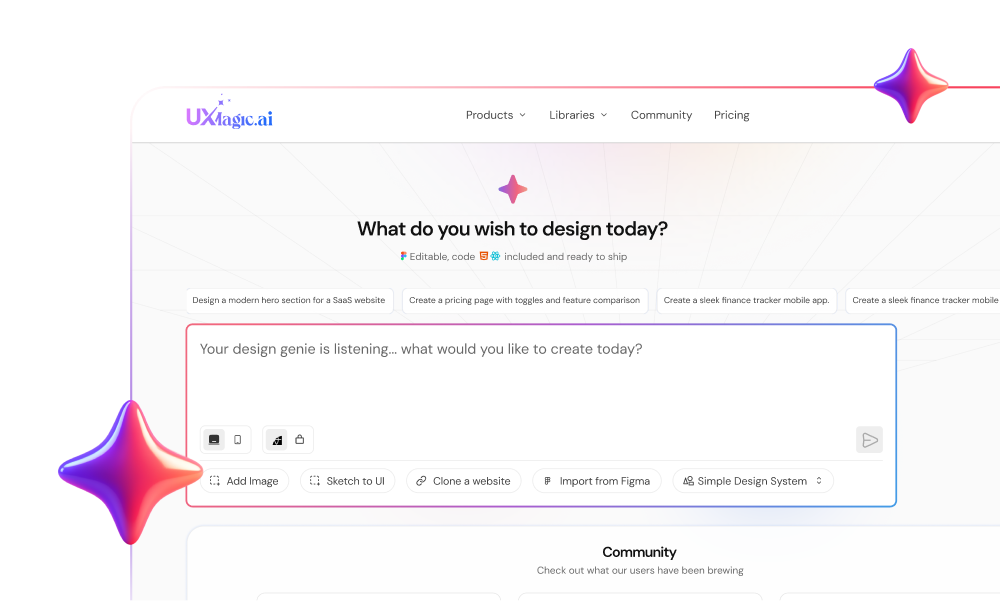
This is where tools like UXMagic matter, but only because they enforce structure.
With Flow Mode, you:
- Lock navigation and layout
- Prevent structural hallucination
- Maintain continuity across screens
AI stops “designing.” It starts compiling.
Runtime HITL Checkpoints
This is non-negotiable.
At decision points:
- AI pauses
- Proposes structured actions
- Human approves or rejects
Use this for:
- Flow branching
- Data handling
- Risk-sensitive actions
No approval = no execution.
Phase 3: Post-Generation (Break It Before Users Do)
Now you attack your own system.
AI does:
- Accessibility scans
- Edge case generation
Human does:
- Fix intent (AI can’t do this)
- Apply heuristics
- Add missing states
- Validate logic
This is how you start automating ARIA integrity without sacrificing design intent, not by trusting AI, but by supervising it.
Achieving Deterministic Consistency at Scale
This is where most teams fail.
They use AI like a design tool.
It’s not.
It’s a compiler.
Raster Prototyping vs. The Component Assembly Model
If your AI generates:
- Flat images
- Pretty mockups
- Non-semantic layers
You’re wasting time.
Production workflows require:
- Component-level generation
- Token alignment
- Code-ready output
UXMagic fits here, not as a generator, but as a constraint enforcer:
- Uses real components
- Locks tokens
- Preserves auto-layout
- Outputs deterministic structure
Preventing Structural Hallucination with Flow Mode
Multi-screen consistency isn’t a “nice to have.”
It’s the entire system.
Flow Mode solves:
- Layout drift
- Navigation inconsistency
- Context loss
By:
- Locking anchors
- Restricting generation zones
- Maintaining structural memory
If your tool doesn’t do this, you’re manually fixing it later.
AI is not your designer.
It’s your fastest intern with zero judgment.
If you don’t define the system, it will improvise one. And you’ll spend your time fixing it.
The teams winning right now aren’t generating better screens.
They’re building better constraints.
Stop Prompting. Start Controlling Your AI Workflow
Eliminate the verification tax and ship consistent, code-ready UI by enforcing constraints, not chasing better prompts.