
You prompt an AI for a “clean SaaS dashboard” and it delivers something beautiful.
Then everything breaks.
New hex codes show up. Padding changes randomly. The next screen looks like it belongs to a different product. Engineering rejects the handoff. And suddenly, your “fast AI workflow” costs more time than building from scratch.
This isn’t a tooling issue. It’s an architectural failure.
If you’ve already tried AI UI tools and felt the gap between pretty screens and production reality, you’re not wrong. You’re just using them at the wrong layer.
Why AI UI Foundations Fail Without Token Architecture
The Core Mismatch: Probabilistic AI vs Deterministic Systems
AI doesn’t “design.” It predicts.
Your system, on the other hand, requires strict logic:
- Consistent tokens
- Predictable component behavior
- Clean mapping to code
That’s the mismatch.
Every time you prompt without constraints, the AI:
- Invents new colors
- Breaks spacing rules
- Outputs hardcoded values
That’s not iteration. That’s entropy.
This is exactly why teams struggle with maintaining AI UI consistency because the system underneath was never defined.
Implementing a Three-Tiered Token System for Scale
If tokens don’t exist before the prompt, you’ve already lost.
You need three layers:
- Global Tokens
Raw values
- blue-500: #0052CC
- spacing-4: 16px
- Semantic (Alias) Tokens
Meaningful assignments
- color-primary-brand → blue-500
- spacing-layout-padding → spacing-4
- Component Tokens
Scoped usage
- button-primary-bg → color-primary-brand
This is what turns AI into a compiler instead of a chaos machine.
Without this, every prompt creates a new design system. And your product slowly becomes a Frankenstein.
The Advanced Workflow: From Prompt to Production
Phase 1: Building the Digital Twin and Logic Matrix
Stop starting with a blank prompt.
Start with constraints.
Define:
- Brand tokens (colors, typography, spacing)
- Reference screens (your “digital twin”)
- Structural patterns (layouts, grids)
Then map the logic:
- User flows
- Decision points
- Failure states
You’re not designing screens. You’re designing a state machine.
Phase 2: Flow-First Prompting and Edge Case Management
Most designers prompt for the “happy path.”
That’s a mistake.
Instead:
- Ask how the system breaks
- Define error states
- Handle missing data
- Account for latency
Example shift:
❌ “Design a clean onboarding flow” ✅ “Map a 3-step onboarding using this JSON structure. Define validation errors, skipped steps, and API failure states.”
This is where most teams fail and why AI outputs look impressive but collapse in production.
If you want to go deeper into this, look at how to prompt AI for SaaS products using structured frameworks instead of vague inputs.
Phase 3: Agentic Editing and React Code Export
Once you generate, don’t regenerate.
That’s how teams destroy their own systems.
Instead:
- Edit sections, not screens
- Preserve layout constraints
- Update components in isolation
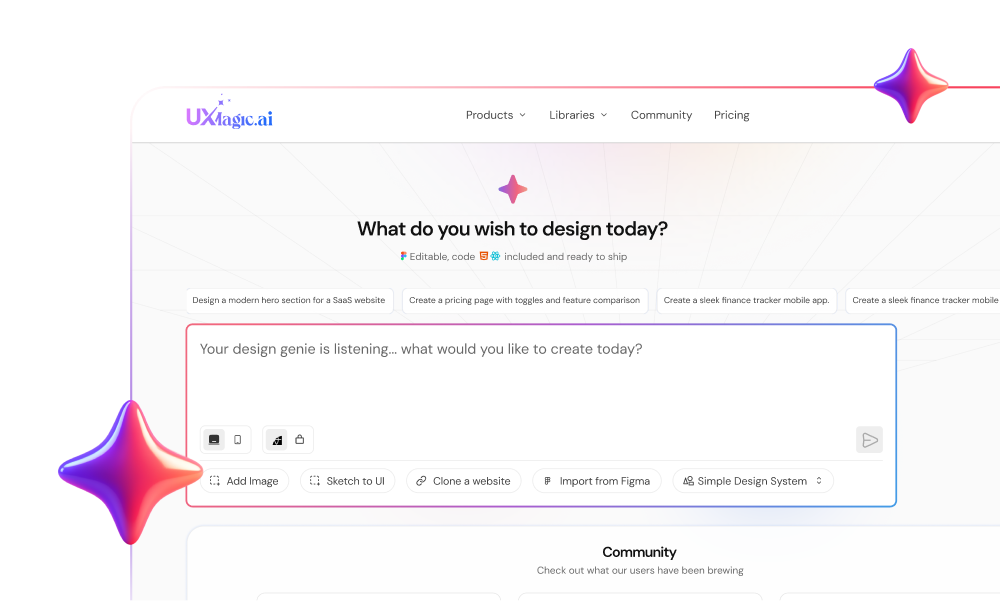
This is where tools like UXMagic actually matter.
Instead of redrawing UI, UXMagic:
- Assembles from real components (not pixels)
- Lets you modify sections without breaking structure
- Exports clean React/Tailwind code
That last part matters.
Because if your design doesn’t map to code, it’s not a system. It’s decoration.
This is how teams finally eliminate the handoff tax instead of pretending it doesn’t exist.
Can AI Create Design Systems? (The Honest Truth)
Eradicating Token Drift with Reference Frame Consistency
Short answer: No, AI cannot create a scalable design system on its own.
It can only follow one.
Without constraints, AI outputs:
- Hardcoded values
- Disconnected components
- Zero semantic structure
To make it work, you must:
- Define tokens first
- Enforce them across flows
- Lock consistency at the system level
This is where UXMagic’s Reference Frame Consistency changes the game.
Instead of hoping the AI stays consistent, it:
- Locks tokens across all screens
- Prevents visual drift
- Maintains structure across flows
You’re not asking AI to “remember.” You’re forcing it to comply.
The Real Impact of AI Design Systems on SaaS Startups
The biggest lie in SaaS is that you must choose between:
- Speed
- Scalability
AI breaks that but only if used correctly.
If you start with tokens:
- You ship fast
- You stay consistent
- You avoid rewrites
If you don’t:
- You accumulate silent tech debt
- You increase engineering friction
- You slow down over time
The real shift isn’t AI.
It’s moving from:
- Screens → Systems
- Prompts → Architecture
- Output → Governance
And if your workflow doesn’t reflect that, AI will amplify your problems not solve them.
If your AI workflow still starts with “make it clean and modern,” you’re not building faster, you’re just delaying the mess.
The teams winning with AI aren’t better at prompting.
They’re better at defining systems AI can’t break.
Related guides
- When You Should Not Use AI for Design
- User Interface Design Guide for Beginners (2026)
- The hidden quality gaps in ai-generated interfaces
- Why Consistency Beats Creativity in SaaS UI
- Where AI Breaks in Design Workflows
- The Spec-Driven Design Workflow for Product Managers (2026 Blueprint)
- The Cost of Slow Design in SaaS
- Why AI Is Not Replacing UX Designers
- How Founders Can Ship Faster Without a Design Team
- What Is UX Design in 2026? A Practical Guide for Shipping Faster
Stop Generating Screens. Start Shipping Systems.
UXMagic turns AI from a guessing engine into a system builder—so your designs actually survive production.