Right now, there is a product manager in your Slack workspace generating a functioning web application with a single text prompt. They call it vibe coding, and while the output looks polished, it’s secretly a fragile mess of hardcoded CSS and disconnected logic.
If design teams don’t take control of this workflow, the next three years of your career will look like debugging hallucinated layouts instead of designing systems.
This article explains what vibe coding actually is, where it breaks, and why the designers who survive 2026 won’t be the fastest prompters, they’ll be the strictest constraint enforcers.
What Is Vibe Coding? The Evolution to Agentic Engineering
Vibe coding is a software development method where you describe a feature in natural language and an AI generates the interface, logic, and scaffolding for you.
The term was coined by Andrej Karpathy in February 2025. It started as a joke about weekend projects. By 2026, it became a $4.7B market changing how product teams ship software.
But most teams misunderstand what vibe coding actually replaces.
It doesn’t replace engineering. It replaces manual interface execution.
Instead of writing syntax, you define constraints. Instead of drawing wireframes, you direct structure. Instead of pushing pixels, you audit systems.
That shift is why teams moving from traditional workflows to AI generation often feel fast on day one and broken by day three.
Especially when they hit the vibe wall.
If you’ve ever watched an AI forget its own spacing rules halfway through a flow, you already know the problem. It’s the same failure mode described in our breakdown of Blank Canvas Syndrome: speed without structure collapses into noise.
Vibe Coding vs. Generative UI (GenUI): The Accountability Shift
Vibe coding and generative UI are not the same thing.
Vibe coding means you prompt the interface into existence. You own the architecture. You own the mistakes.
Generative UI (GenUI) means the system decides what interface to generate based on user context. The system owns the decision.
Most teams blur this boundary. That’s dangerous.
Treating vibe-coded output like GenUI leads to passive design behavior:
- no constraint enforcement
- no token discipline
- no accessibility verification
- no state logic validation
And that’s how prototypes quietly become production liabilities.
Why Vibe Coding is Accelerating the Erosion of Design Authority
The biggest misconception about vibe coding is that it threatens designers.
It doesn’t.
It threatens unconstrained workflows.
The “Context Amnesia” Epidemic and the Vibe Wall
Large language models generate interfaces statelessly unless forced otherwise. That means Screen 4 often forgets Screen 1 ever existed.
Typical symptoms:
- typography scales drift mid-flow
- navigation disappears
- padding changes randomly
- tokens get replaced with arbitrary hex values
Teams call this context window collapse. Designers call it the vibe wall.
This is why tools that generate isolated screens fail at real product flows. Designing disconnected frames is not designing software.
It’s generating screenshots.
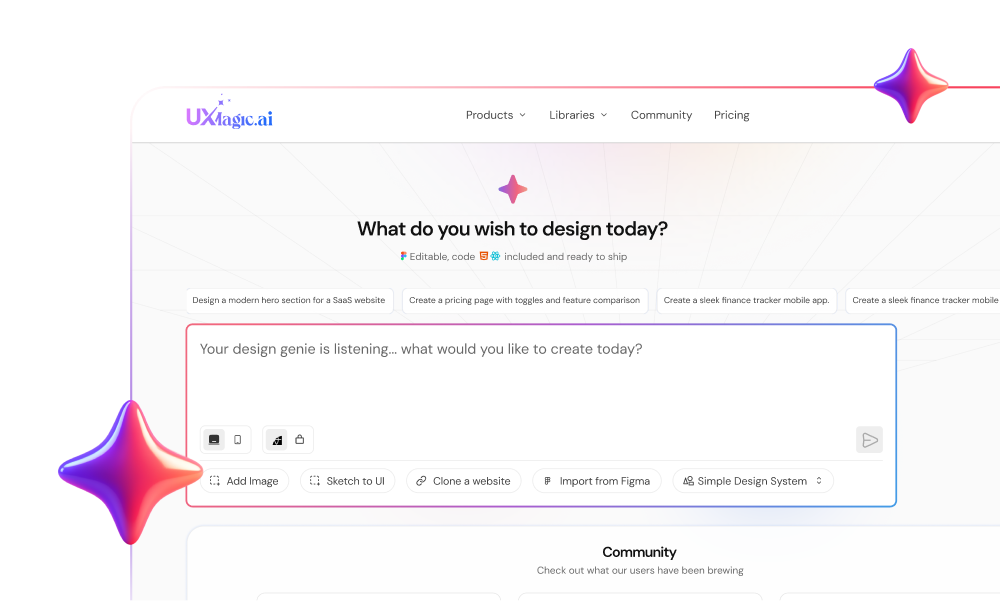
Platforms like UXMagic address this with Flow Mode, which locks navigation structure, spacing tokens, and component rules across screens so the interface behaves like a system not a slideshow.
Generism, the “Ikea LACK” Effect, and the Death of Craft
AI outputs average design.
Not great design. Not bad design. Average design.
That’s because models train on internet-scale UI patterns. The result is what critics call generism interfaces that look modern but interchangeable.
Symptoms include:
- Tailwind-looking dashboards everywhere
- identical onboarding flows across competitors
- flattened visual hierarchy
- no brand voice in layout decisions
Creativity inside component styling isn’t differentiation. Consistency across workflows is.
Systemic consistency beats aesthetic novelty every time in SaaS.
The Security Crisis: Speed vs. Maintainability
Speed is the biggest lie in vibe coding.
A CodeRabbit analysis of 470 pull requests showed AI-coauthored code contained 1.7× more major issues and 2.74× more security vulnerabilities than human-written code.
A Veracode report found 45% of generated code samples fail basic security tests.
That’s not acceleration.
That’s deferred failure.
Most teams feel fast because scaffolding appears instantly. They only notice the slowdown later while fixing hallucinated dependencies, broken joins, and fragile state logic.
The New Workflow: Shifting from Vibe Coding to Agentic Engineering
The real shift isn’t AI replacing design.
It’s design replacing execution with constraint architecture.
Here’s what that workflow actually looks like.
Step 1: Intent Definition (The Brief)
Most teams prompt like this:
“Build a dashboard.”
That’s not prompting. That’s wishful thinking.
Treat the model like a junior intern with zero memory. Define:
- layout structure
- component hierarchy
- token usage
- accessibility expectations
- definition of done
If you don’t specify constraints, the model invents them.
Our guide on [How Designers Actually Use AI in Real Projects (https://uxmagic.ai/blog/ai-in-ux-design-workflow) breaks this shift down in practical workflows.
Step 2: Generative Scaffolding (Layer 1)
Layer 1 output is a draft.
Not production UI.
Never ship scaffolding directly. Evaluate:
- semantic HTML structure
- responsiveness
- token adherence
- interaction states
Skipping this review is how inaccessible interfaces reach staging environments.
Step 3: The “Vibe Check” / Quality Gate Implementation
This is where designers stop being pixel pushers and become system auditors.
Run every generated screen through:
- WCAG contrast validation
- ARIA labeling checks
- token alignment verification
- navigation consistency tests
If accessibility isn’t inside your prompt architecture, it won’t appear in the output. That’s why constraint-based prompting matters, see Prompting for Accessibility.
Step 4: Iterative Refinement and Flow Integration (Layer 2)
Single screens are easy.
Connected journeys break everything.
This is where context collapse usually happens:
- headers drift
- modals detach from flow logic
- typography resets mid-journey
Flow-first systems prevent regeneration chaos by persisting layout rules across screens.
Instead of rebuilding context every prompt, you extend it.
Step 5: Agentic Engineering Handoff
Once tokens, accessibility, and structure are verified, AI stops being experimental.
It becomes infrastructure.
This stage is agentic engineering:
AI handles repetition. Humans enforce architecture.
That’s the workflow shift designers need to survive vibe coding adoption.
How to Fix the “Vibe Wall” (Solving Context Collapse with Flow Mode)
The vibe wall isn’t a prompt problem.
It’s a memory problem.
Most generators rebuild every screen from scratch. That’s why styles drift across onboarding flows and dashboards lose navigation between states.
Flow-based systems solve this by persisting:
- spacing tokens
- header structures
- typography rules
- navigation logic
Instead of generating isolated components like v0, or fragile full-stack scaffolding like Lovable, flow-aware environments maintain continuity across journeys.
UXMagic’s Flow Mode does exactly this. It locks global styles so Screen 2 cannot hallucinate a new design language that contradicts Screen 1.
You design the movie not the frames.
That shift eliminates most verification tax designers currently absorb from generic generators.
If your prompts still produce disconnected layouts, the issue isn’t your wording. It’s your tooling.
Stop Shipping Screens. Start Shipping Systems.
Vibe coding isn’t replacing designers, it’s exposing which workflows were never structured enough to survive automation. The teams shipping reliable AI-generated interfaces in 2026 aren’t prompting faster. They’re enforcing stronger constraints, tighter tokens, and connected flows from the start.
Stop acting as a verification janitor for hallucinated CSS and broken interaction states. Build one real multi-screen feature using structured flow constraints instead of isolated prompts. Try UXMagic’s Flow Mode and generate a connected journey that actually respects your tokens from the first screen to the last.
Stop Debugging Hallucinated UI
Generate a real multi-screen flow with locked tokens, persistent navigation, and production-ready structure. Try UXMagic Flow Mode free and ship your next feature without the vibe wall.