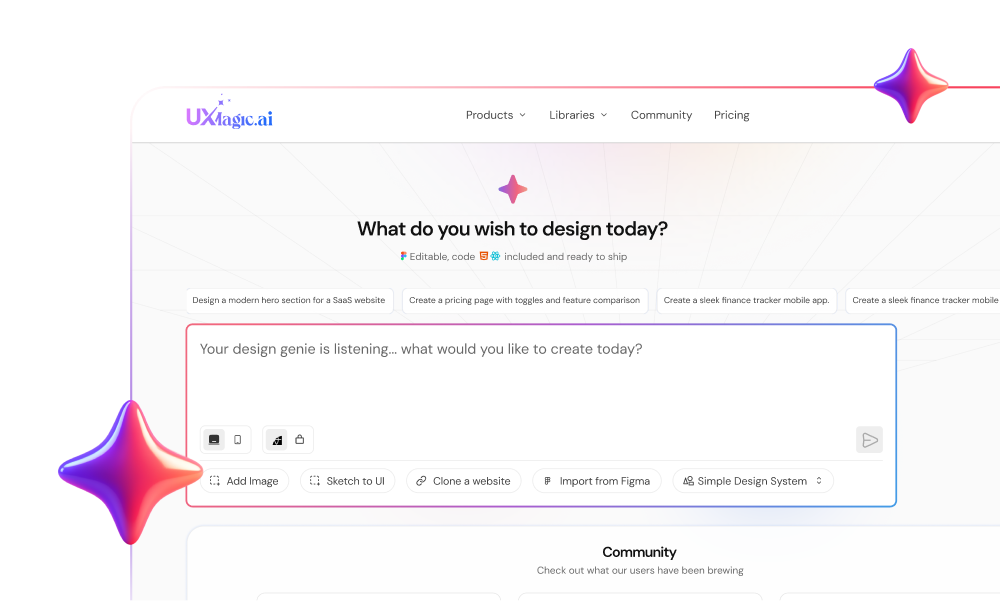
Software subscription budgets are bleeding out through seat taxes, where paying $20 a month per user just to sketch disposable gray boxes represents real capital inefficiency. Managing tiered editor roles and metered AI credit overages has turned simple wireframing into an administrative headache for design leads. An audit of wireframing tool return on investment is no longer optional - it's an operational necessity.
The core formula worth keeping in mind throughout this whole piece:

Most tool comparisons only ever price the first term. Everything below is really about pricing the other four.
One caveat before any numbers below: every example in this guide will shift meaningfully depending on your designer's hourly rate, team size, and how complex the actual flow is. Treat the illustrative examples as a way of thinking through the calculation, not a fixed number to expect on your own project.
You already understand design systems, component variables, responsive grids, and basic developer handoff mechanics. This isn't a primer on the difference between a wireframe and a mockup. It's the actual cost math - seat pricing tiers, the hidden labor cost of manual translation, AI credit metering - that most tool comparison listicles skip entirely.
The Hidden Costs of Modern Wireframing Software
Editor Seat Taxes and Dev Mode Surcharges
Figma's seat-based pricing structure actively disincentivizes cross-functional product discovery. As of September 2026, per Figma's official pricing page, Figma prices seats by role rather than a single flat rate: a Full seat runs $16 per editor per month on Professional (billed annually; $20 monthly), a Dev seat runs $12 per month, and a Collab seat runs $3 per month. Organization tier jumps to $55 per seat per month, annual-only, and Enterprise runs $90 per seat. Every Full seat also carries a monthly AI credit pool that meters overage separately - a second cost running on top of the seat price itself.
Faced with that structure, teams often respond by restricting editor access for product managers and engineers rather than actually right-sizing seat types. That pushes early discovery back onto static whiteboards or paper, re-introducing exactly the operational silos the tool was supposed to eliminate.
The Real Labor Cost of Static Low-Fidelity Tools
Deliberately low-fidelity sketch tools like Balsamiq can create redundant double-work that outweighs their lower entry price. Intentionally rough tools genuinely help prevent stakeholders from obsessing over visual polish during early reviews - that part of the pitch is real. What they don't solve: forcing designers to manually recreate every approved screen in Figma from scratch afterward.
Balsamiq itself adds a forcing function to this calculation. Per Balsamiq's own official announcement, sales of Balsamiq for Desktop will stop on December 31, 2026, with support continuing through December 31, 2027 - pushing teams that relied on the desktop app toward Balsamiq Cloud regardless of whether they wanted to migrate.
Tool Comparison at a Glance
| Tool | Price | Multi-Screen Flows | Figma Export | Code Export | Hidden Cost |
|---|---|---|---|---|---|
| Balsamiq | Desktop sales end Dec 31, 2026; Cloud tiers vary | No — isolated frames | No | No | Manual rebuild for production |
| Whimsical | $10/editor/mo annual, $12 monthly | No — isolated frames | No | No | Manual rebuild for production |
| Figma (Professional) | $16/editor/mo Full seat annual ($20 monthly); Dev $12; Collab $3 | Manual, but high fidelity | Native | Via plugins | Design time for layout assembly |
| Penpot | Free, open-source | Manual | Native (Figma-compatible) | Limited | Design time remains even without software fees |
| Visily | ~$11/editor/mo | Limited | Yes | Limited | Manual cleanup for visual and token consistency |
| UXMagic | Free tier (30 credits, up to 5 screens); Pro ~$17.5/mo (1,200 credits, up to 200 screens) | Yes, connected flows | Yes, structured | Yes (React/HTML) | AI usage limits and any additional generation needs |
Comparing Wireframing Platforms by Workflow Value
Low-Fidelity Sketch
Balsamiq and Whimsical genuinely excel at one thing: keeping a first conversation about structure focused on structure, not color and typography debates. Where they fall short consistently is export - a sketch built here almost always needs a full manual rebuild the moment it moves toward production, which is exactly the "double work" problem covered above.
All-In-One Design Ecosystems
Figma remains a widely adopted production design platform, but its seat economics punish casual, cross-functional use specifically - a PM who opens the file twice a quarter still needs a seat assignment that costs real money. Penpot, an open-source alternative, eliminates seat licensing costs entirely for core vector design work, a genuinely strong option for teams optimizing hard for software spend over ecosystem maturity.
AI-Powered UI Generators
This category is where the real 2026 cost conversation is happening, and it splits into two meaningfully different sub-categories worth separating clearly - we broke this whole space down in more depth in our roundup of the best wireframing tools if you want the fuller comparison beyond just the cost angle here.
Evaluating AI Wireframe Generators: Single Screens vs. Connected Flows
Single-screen AI generation can quietly worsen design debt rather than reduce it. Generative tools that focus on isolated single prompts rather than structural user flows tend to produce visual and functional inconsistencies - mismatched button styles, disconnected navigation logic between screens - that can require more cleanup time than traditional manual wireframing would have taken in the first place. Evaluate any AI wireframe generator specifically on whether it connects multiple screens with consistent structural logic, not on how polished any single generated frame looks in isolation. UXMagic's AI Wireframe Generator was built around exactly that requirement - producing connected screens instead of isolated frames someone has to manually stitch together afterward.
Vibe-coding platforms don't eliminate the need for structural UX wireframing either. Prompting code platforms like v0, Lovable, or Bolt.new directly, without upfront user flow modeling, can produce logic gaps, weak edge-case handling, and frontend architecture that requires additional refactoring when structural UX isn't defined first. The wireframing step isn't legacy overhead being replaced by code generation - it's a genuinely different, still-necessary layer that happens to now be faster to execute than it used to be.
The Three-Phase Modern Wireframing Workflow
Phase 1: Product Requirements and Logic Mapping (Pre-Wireframing)
Before visual layouts get drawn, product managers and design leads map functional requirements, user roles, permission states, and edge cases. The most common mistake at this stage: skipping explicit flow logic and jumping straight into single-screen layout, which reliably produces missing validation states and broken navigation models discovered during development instead of before it.
Phase 2: Structural Flow Wireframing (Active Wireframing)
Teams translate functional requirements into low- or mid-fidelity structural interfaces. This is where product teams hit the greatest velocity bottleneck - designers spend real hours building basic layout grids by hand in manual tools, while legacy sketching tools generate static layouts that can't be translated into production assets at all.
Phase 3: Design System Mapping and Code Handoff (Post-Wireframing)
Approved wireframes transition into high-fidelity design systems or export directly for front-end engineering. Friction occurs specifically when teams have to manually recreate low-fidelity concepts inside production design environments. Exporting directly to clean Figma vectors or production React and HTML code eliminates that redundant translation layer static wireframing software requires.
Real-World Cost Scenarios, With the Full Math
B2B SaaS multi-step onboarding flow. A product manager and designer at a Series A SaaS company needs to map a four-step onboarding sequence. Assuming a fully-loaded designer rate of $75/hour for illustration purposes only (adjust for your own team's real rate):
| Cost Factor | Legacy Workflow | AI-Assisted Workflow |
|---|---|---|
| Software cost | Whimsical ($10/mo) + Figma Full seat ($16/mo) = $26/mo | UXMagic Pro (~$17.5/mo) |
| Design hours | ~16 hours (2 days) recreating sketches as Auto Layout | ~1 hour reviewing and lightly adjusting the flow |
| Hourly labor cost | 16 hrs × $75 = $1,200 | 1 hr × $75 = $75 |
| Rework | 2–3 cycles × ~4 hrs = 8–12 hrs ($600–$900) | 1 cycle × ~1 hr ($75) |
| Handoff | Manual annotation and spec-writing, ~3 hrs ($225) | Minimal — structured export reduces manual work |
| Total effective cost | ~$2,050–$2,350 | ~$225–$250 |
The software line item is the smallest number in the entire table on both sides - which is exactly the point this whole guide is making. The real cost lives in labor hours, and that's where the gap actually opens up.
Enterprise data analytics dashboard redesign. A design lead needs to restructure a complex dashboard.
| Factor | Legacy Workflow | AI-Assisted Workflow |
|---|---|---|
| Approach | Abstract gray-box wireframes focused on structure | Mid-fidelity dashboard with realistic data tables |
| Stakeholder clarity | Lower — abstract boxes can make spatial relationships harder to evaluate | Higher — realistic hierarchy makes layout easier to assess |
| Review cycles | 3+ additional cycles | 1 |
This math changes significantly depending on designer rate, team size, and how complex the actual flow is - a junior designer at a lower rate, or a two-screen flow instead of a five-screen one, will produce a very different gap than the illustration above. Treat these as worked examples of the method, not a number to expect on your own project.
Where generic AI tools fail in both scenarios: text-to-UI generators without flow architecture tend to produce visually distinct, disconnected screens with inconsistent button alignment and zero connected navigation logic - eating most of the time the tool was supposed to save.
Which Type of Team Fits Which Tool?
- Balsamiq / Whimsical - teams doing early, low-fidelity discussion where the goal is keeping stakeholders focused on structure, not final output
- Figma - teams with detailed product design needs and an already-established, actively maintained design system
- Penpot - teams where licensing cost is the primary constraint, and in-house engineering time for self-management is available
- v0 / Lovable / Bolt.new - teams that genuinely want code first and are prepared to handle the wireframing step separately, since these tools don't replace it
- UXMagic - teams where connected multi-screen journeys, clean handoff, and holding the whole "Total workflow cost" formula down matters more than single-frame polish - this covers most small-to-mid product teams without dedicated design-ops support, which is why it's the primary recommendation throughout this guide
Final ROI Verdict: How to Build an Efficient Design Stack
- Right-size Figma seats immediately - audit who actually needs Full editor access versus Collab (view/comment) access.
- Replace non-exporting sketch tools - if a wireframing tool can't export to vector or code, the "savings" on its subscription price are an illusion once the manual rebuild hours get counted.
- Evaluate AI generators on flow connection, not frame polish - this is the single biggest driver of the cost gap in both worked scenarios above, and it's the specific problem UXMagic was built to solve.
- Consider Penpot for teams optimizing hard on software spend specifically, though the labor-hours side of the cost formula stays largely unchanged either way.
- Set fidelity expectations before reviews so feedback stays useful instead of drifting into color debates on a gray-box wireframe.
Build Connected Wireframe Flows
Generate connected, exportable multi-screen UI flows from a prompt and reduce the design labor and rework hidden inside traditional wireframing workflows.