The digital product landscape is drowning in homogenous AI-generated slop. Senior designers are stuck defending their value while stakeholders assume a prompt can replace a design system overnight.
If you’re spending more time fixing broken spacing, hardcoded hex values, and detached components from AI output than designing actual flows, your workflow isn’t fast it’s fragile. The real web design trends 2026 teams care about aren’t visual styles. They’re system behaviors.
2026 isn’t about generating screens faster. It’s about forcing AI to respect tokens so you can ship production-ready journeys instead of polishing disposable mockups.
The Death of “AI Slop” and Visual Gimmicks in 2026
Most “trend reports” still talk about typography moods and hero layouts. That advice is outdated.
UI production is now cheap. System logic is expensive.
Execution-only interfaces are automated. What differentiates products in 2026 is intent orchestration, how interfaces adapt to behavior, context, and machine interpretation.
Let’s be blunt about what’s fading:
- Glassmorphism breaks contrast compliance
- Heavy 3D hurts rendering performance
- Floating AI chat widgets interrupt workflows
- Theme-based generators ignore your design tokens
These aren’t trends. They’re regressions.
Design teams shipping real SaaS products are replacing visual gimmicks with:
- semantic architecture
- adaptive layouts
- progressive disclosure
- ambient intelligence
And if your AI tool invents new spacing values or color tokens mid-flow, you’re not accelerating. You’re accumulating technical debt.
This is exactly why teams moving beyond isolated screen generators now rely on system-constrained workflows like the ones described in How Designers Actually Use AI in Real Projects where consistency is enforced before generation starts.
5 Web Design Trends Actually Driving SaaS Revenue
These are the web design trends 2026 teams are investing in because they improve activation rate, reduce churn, and shorten time-to-value.
Not because they look modern.
- Designing for Intent and Progressive Disclosure
Static dashboards are still killing onboarding.
New users land on screens filled with empty widgets, tooltip tours, and metrics they don’t understand yet. They leave within minutes.
Intent-based design fixes this by adapting layout structure to user readiness.
Instead of showing everything:
- empty states become onboarding moments
- charts appear only after data exists
- navigation changes based on goals
- CTAs reflect the next logical action
Most teams try solving churn with visual redesigns. That’s the wrong lever.
The real fix is progressive disclosure.
Example:
Before A dashboard loads with 10 inactive charts and a tooltip tour nobody reads.
After The interface shows one clear action: “Connect your data source.”
Everything else stays hidden until it’s relevant.
That’s not styling. That’s cognitive load reduction.
It’s also why teams struggling with early-stage interface momentum often start by fixing Blank Canvas Syndrome before touching visuals at all.
- Ambient AI (When Interfaces Disappear)
Adding a floating chat assistant is not innovation. It’s avoidance.
Chat widgets force users to translate intent into prompts. Good interfaces eliminate that step entirely.
Ambient AI predicts actions instead of requesting instructions.
Instead of:
“Type what you want.”
The interface becomes:
“I already moved the next thing you need.”
Examples:
- navigation reorders itself based on usage patterns
- relevant filters surface automatically
- categories adapt to behavioral signals
- actions appear before users search for them
This reduces interaction friction dramatically.
The difference is subtle but structural:
Chat-based AI = interruption Ambient AI = acceleration
And teams that embed intelligence directly into layout behavior consistently outperform teams that bolt it on as a feature.
- MX (Machine Experience) Design and Semantic Architecture
This is the trend most designers are still ignoring.
If AI agents can’t parse your interface, your product becomes invisible before users ever see it.
Machine Experience (MX) design prioritizes:
- semantic HTML hierarchy
- logical heading structures
- structured information architecture
- machine-readable accessibility labels
Search assistants and autonomous agents interpret your product long before humans do.
If they fail to summarize your features correctly, your UX never gets a chance.
Designing for humans alone is no longer enough.
Designing for machines first is now a discoverability requirement.
And this shift is why accessibility prompting strategies like those in Prompting for Accessibility are no longer compliance checkboxes. They’re visibility infrastructure.
- The Archival Index Aesthetic (Replacing Glassmorphism)
Glassmorphism isn’t futuristic anymore. It’s fragile.
It increases cognitive load. It complicates contrast compliance. It slows rendering on mid-tier devices.
Teams shipping serious SaaS interfaces are moving toward what’s effectively an archival index aesthetic:
- structured layouts
- semantic grouping
- typography-led hierarchy
- performance-first minimalism
This isn’t about making products look simpler.
It’s about making systems interpretable faster by both humans and machines.
And because accessibility enforcement is now a day-one requirement across half the industry, visual restraint is becoming a competitive advantage.
- Modular UI and Usage-Based Adaptive Dashboards
Static dashboards assume every user wants the same information.
They don’t.
Adaptive dashboards reorganize themselves around behavior signals.
Instead of:
One layout for everyone
You get:
Different layouts per intent profile
Examples include:
- hiding inactive modules automatically
- elevating frequently used components
- restructuring navigation priority
- adjusting layout density dynamically
This reduces onboarding friction and increases feature adoption without adding complexity.
It’s also the foundation for multi-modal interfaces, where typed input, voice interaction, and fallback states coexist inside the same logic system instead of living in separate flows.
The 2026 AI Workflow: How to Implement Trends in Hours, Not Weeks
Understanding trends isn’t useful unless you can implement them inside a real design system.
Here’s what modern teams actually do.
Phase 1: Intent Mapping and MX Architecture
Start with logic, not layout.
Define:
- informational intent
- navigational intent
- commercial intent
- transactional intent
Then structure semantic hierarchy accordingly.
Skipping this step guarantees unusable AI output later.
Phase 2: Establishing System Constraints
Most generators fail here.
They invent tokens.
They guess spacing.
They hallucinate typography.
That’s how “vibe coding” creates technical debt.
Production workflows lock down:
- spacing rules
- typography hierarchy
- semantic color roles
- component tokens
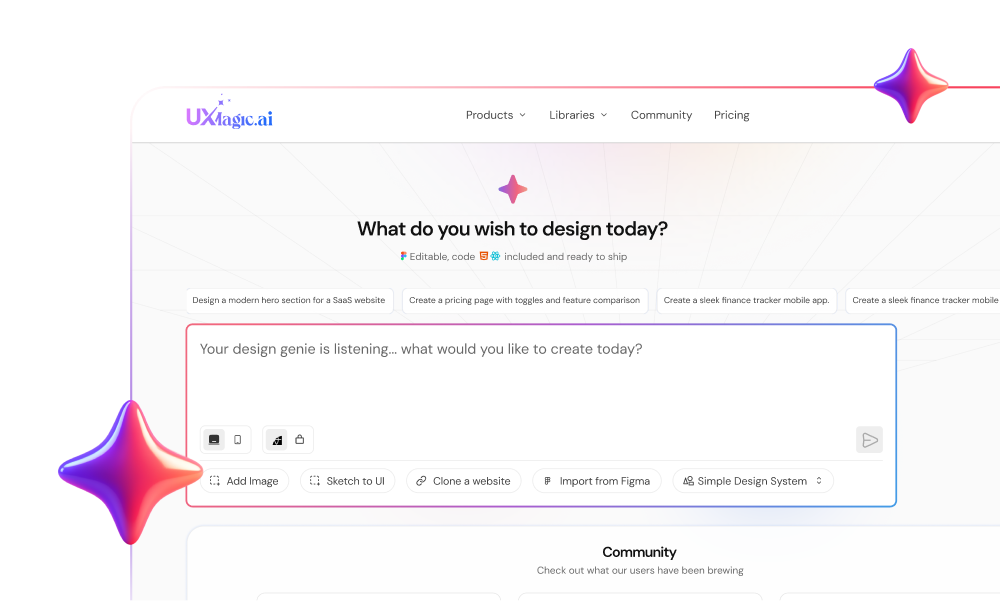
This is where system-aware tools like UXMagic ingest existing Figma libraries so generation respects your constraints instead of replacing them.
Phase 3: Prompt-Driven Flow Generation
Single-screen prompting breaks continuity.
Always generate journeys instead.
Modern workflows generate:
- dashboard state
- empty state
- active state
- settings modal
in one pass.
UXMagic’s Flow Mode maintains contextual memory across these screens so spacing logic and interaction patterns stay aligned across the entire sequence.
That eliminates the stitching work designers used to do manually.
You can see how similar production-ready prompting patterns work in Real Prompts We Use.
Phase 4: Agentic Refinement and Contextual Adjustment
Never accept first output.
Use AI as a critique partner:
- rebalance layout density
- validate contrast compliance
- shift desktop-heavy structures mobile-first
- test edge-case interaction states
This is where human judgment creates leverage. Not pixels.
Phase 5: Seamless Handoff and Intent-Based Adaptation
When tokens stay intact, developer handoff becomes frictionless.
No hardcoded anomalies.
No spacing inconsistencies.
No semantic breakdowns.
Engineering teams can immediately instrument adaptive interfaces that reorder components based on live behavioral signals.
That’s how velocity increases without sacrificing maintainability.
The Evolving Role of the Strategic Product Designer
Execution-only UI roles are disappearing.
Strategic orchestration roles are expanding.
Designers now operate across:
- intent mapping
- semantic architecture
- accessibility prompting
- component logic definition
- adaptive layout behavior
The job isn’t drawing screens anymore.
It’s defining system behavior under constraints.
And the teams that adopt human-in-the-loop generation models like the workflow described in Human in the Loop AI Design, consistently avoid the instability caused by uncontrolled automation.
AI doesn’t replace designers.
It replaces repetition.
Web design trends in 2026 aren’t about visual polish anymore — they’re about system intelligence. Teams that design for intent, enforce tokens, and generate full flows instead of isolated screens will ship faster, reduce churn, and stay discoverable in an AI-first web. The rest will keep fixing “AI slop.”
Stop shipping isolated screens
Most teams don’t lose velocity because they lack ideas.