Most Bolt.new reviews stop at “it builds apps from prompts.” That’s not the question serious teams are asking anymore.
The real question is whether Bolt.new review 2026 should end with “ship it” or “rewrite it.” Because generating a landing page in 60 seconds isn’t impressive in 2026. Shipping maintainable SaaS logic is.
If you’re deciding whether Bolt.new belongs in your production stack or just your demo workflow, this is where the technical cliff actually appears.
Bolt.new Review 2026: AI App Builder or Prototyping Sandbox?
The Reality of Browser-Based WebContainers and Vibe Coding
Bolt.new runs inside browser-based WebContainers. That’s the magic.
No local setup. No package installs. No terminal rituals. You prompt, it scaffolds, and the UI updates instantly.
For the first 10–20 components, this workflow is legitimately fast:
- routing appears automatically
- npm packages install themselves
- layouts render live in the browser
- APIs connect with minimal friction
This is why hackathon teams love it.
But most guides treat “vibe coding” like a production strategy. That’s wrong. Vibe coding generates disposable architecture. It skips the logic phase that prevents downstream rewrites.
If you’ve ever shipped React at scale, you already know why skipping structure creates technical debt faster than it saves time.
That’s exactly why teams who skip wireframes end up generating fragmented flow something explored in detail in this breakdown of Blank Canvas Syndrome in AI UX workflows.
Understanding the “Technical Cliff” in Generative UI Development
Bolt.new works best before complexity enters the system.
The moment you introduce:
- multi-tenant routing
- database policies
- role-based access
- async state orchestration
the platform enters what practitioners now call the technical cliff.
Example:
A founder builds a Supabase authentication flow with role-based dashboards.
Step one: login UI appears instantly. Step two: redirect logic starts looping. Step three: tokens burn trying to fix invisible architectural errors.
Five million tokens later, the root issue still exists.
At that point, the workflow shifts from generation to recovery.
Bolt.new Pricing and Token Limits Explained
How the 300K Daily Free Limit Actually Performs in Practice
Bolt.new’s free tier includes:
- 1M tokens monthly
- 300K tokens daily
- hosting support
- database connections
- private projects
On paper, that sounds generous.
In practice, 300K tokens disappears quickly when:
- modifying routing logic
- restructuring components
- debugging state
- adjusting backend integrations
Hit the cap and work stops for 24 hours unless you upgrade.
That’s fine for weekend experiments. It’s not fine for iterative product work.
Why the Pro Plan’s 10 Million Tokens Drain Faster Than Expected
The $25/month Pro plan removes the daily cap and adds 10M tokens monthly.
Here’s the catch most marketing pages skip:
Bolt.new synchronizes the entire project file tree on every prompt.
As projects scale, token usage scales exponentially.
Developers report burning:
- 7–12M tokens fixing routing conflicts
- 12–20M tokens resolving auth bugs
- entire monthly allocations in a single debugging loop
At that point, tokens stop behaving like credits. They behave like a tax on architectural uncertainty.
If your workflow depends heavily on iterative prompting, token economics become unpredictable fast.
Core Limitations: Where Bolt.new Fails in Production SaaS
Token Drift and the Abandonment of Design Systems
Bolt.new is a code generator, not a design governance tool.
Across multi-screen flows, it gradually forgets earlier layout decisions. This leads to token drift, where the system:
- changes spacing logic
- swaps hex values
- alters border radii
- injects arbitrary Tailwind classes
Example from a 20-screen enterprise prototype:
Screen 1 followed typography rules. Screen 7 replaced spacing tokens. Screen 12 introduced new colors entirely.
Now QA rejects the build.
This is exactly why logic-first workflows outperform screen-by-screen prompting and why structured pipelines like human-in-the-loop AI design workflows exist in the first place.
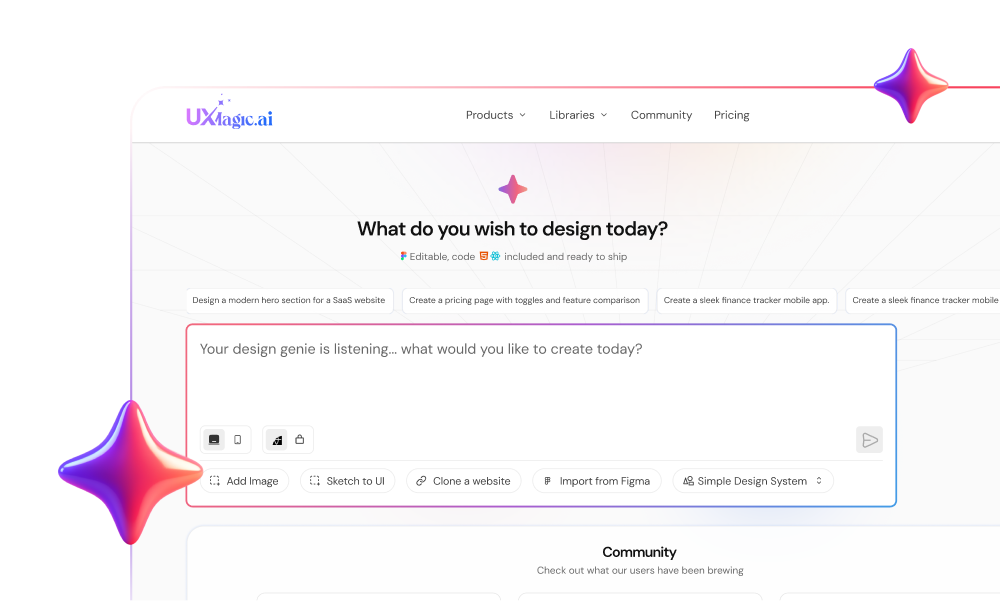
Tools like UXMagic solve this by enforcing Flow Mode constraints across journeys instead of generating isolated screens. The system preserves spacing tokens and typography rules automatically, eliminating corrective prompt loops later.
Supabase RLS and Architectural Hallucinations
Bolt.new integrates with Supabase smoothly at first.
Authentication scaffolds quickly. Tables spin up instantly. Basic queries work.
But complex backend logic exposes the limits:
- Row Level Security policies misconfigure
- redirect loops appear
- auth context providers break
- deployment fails silently
Developers often eject the project and finish infrastructure manually.
That defeats the promise of a zero-setup environment.
Monolithic Code Duplication
Instead of abstracting reusable components, Bolt.new frequently duplicates raw UI logic across files.
Example:
A data table appears in eight screens.
Instead of one shared component, the platform generates eight separate implementations.
Result:
- bloated codebases
- failed architecture audits
- mandatory refactoring before production
Component-scoped generators like v0 avoid this problem entirely.
Corrupted Refactors Without Rollback Safety
Bolt.new lacks granular native version control.
One misunderstood prompt can trigger:
- cascading refactors
- layout regressions
- routing failures
- component breakage
Without rollback checkpoints, teams export code repeatedly just to stay safe.
That slows collaboration more than it accelerates development.
Bolt.new vs Competitors: The 2026 AI Developer Landscape
The industry keeps asking which builder is “best.”
That question assumes these tools do the same job. They don’t.
They operate at different layers of the stack.
Bolt.new vs v0: Production Code Quality vs Convenience
Bolt.new generates full-stack scaffolds quickly.
v0 generates production-ready React components intentionally.
For serious frontend systems:
- v0 produces modular output
- Bolt.new produces duplicated structures
Bolt.new wins early speed. v0 wins long-term maintainability.
Bolt.new vs Lovable: The Race to a Deployable MVP
Lovable targets founders validating ideas fast.
Bolt.new targets developers exploring architectures quickly.
If the goal is:
- investor demo → Bolt.new works
- Supabase-backed MVP validation → Lovable is faster
- scalable SaaS foundation → neither alone is sufficient
Choosing correctly saves weeks later.
Bolt.new vs UXMagic: System Logic vs Code Execution
Bolt.new starts with code.
UXMagic starts with structure.
That difference matters more than most teams expect.
When building 15+ screen flows inside Bolt.new, layout memory degrades across screens. Navigation consistency breaks. spacing tokens shift.
UXMagic’s Flow Mode prevents that entirely by enforcing hierarchy before React exists.
Instead of fixing drift after generation, teams define:
- typography scales
- spacing tokens
- component behavior
- accessibility constraints
Then generate.
This mirrors how experienced teams already work and aligns with workflows described in how designers actually use AI in real projects.
The Token Economy Problem Most Reviews Ignore
Most Bolt.new reviews treat tokens like usage credits.
They’re not.
They’re architecture bandwidth.
Because every prompt synchronizes the full project tree:
- small apps stay cheap
- large apps become expensive
- debugging becomes unpredictable
If the model introduces a structural error, users pay tokens to fix it.
That reverses the normal economics of automation.
Scenario Breakdown: Where Bolt.new Works (and Where It Doesn’t)
Scenario 1: Multi-Tenant SaaS Authentication
Goal: Role-based dashboards with secure database isolation.
Outcome:
Login UI generated instantly. Redirect logic loops. Auth provider fails silently.
After millions of tokens burned, developers export the code and rebuild manually.
Time saved: minimal.
Scenario 2: Enterprise Design System Enforcement
Goal: 20-screen financial dashboard using strict typography and spacing tokens.
Outcome:
First three screens correct.
Later screens drift:
- padding shifts
- colors change
- accessibility contrast breaks
QA rejects output.
Fixing prompts takes longer than building components manually.
This is exactly why production teams rely on spec-driven prompts like those shown in real prompts used for production-ready SaaS UI instead of open-ended generation.
Scenario 3: Investor Demo Prototype
Goal:
Clickable analytics dashboard in 48 hours.
Outcome:
Success.
API connects. Charts render. Deployment works.
Prototype raises funding.
Codebase discarded afterward.
This is Bolt.new at its best: disposable realism.
##The Market Is Misunderstanding “Vibe Coding”
Skipping wireframes doesn’t accelerate delivery.
It accelerates rework.
AI builders that jump directly from prompts to styled UI produce:
- fragmented navigation logic
- broken progressive disclosure
- inconsistent accessibility structures
They generate what teams now call AI slop interfaces that look modern but collapse under real usage.
Structured prompting workflows especially accessibility-aware ones like prompting AI for WCAG-aligned UI ,exist specifically to prevent this.
Ignoring structure isn’t speed. It’s deferred complexity.
Where Bolt.new Actually Fits in a Modern Stack
Bolt.new excels at:
- hackathon builds
- internal tooling
- demo prototypes
- early layout exploration
It struggles with:
- modular architecture
- strict design systems
- backend policy enforcement
- production deployment stability
Segmenting your stack correctly prevents wasted cycles later.
A resilient workflow typically looks like:
- define flows and constraints
- validate structure
- generate components
- integrate backend logic
Starting with raw code generation reverses that order.
Stop Treating Bolt.new Like a Production Builder
Use Bolt.new for speed where speed matters.
But if your workflow starts with raw code generation instead of system logic, expect token drift, duplicated components, and silent deployment failures to show up before your first real release.
Bolt.new is excellent at generating fast prototypes, but unreliable for production-scale SaaS logic. The moment your workflow depends on stable architecture, design system consistency, or backend policy enforcement, token burn and refactoring overhead erase most of its speed advantage. Treat it as a prototyping engine not a foundation layer.
Design flows before AI breaks them
Stop fixing spacing drift and duplicated components after generation. Try UXMagic free and lock your system logic before React ever gets written.