
TL;DR
Design system governance defines who can change a shared system, what evidence a change requires, and how design, code, documentation, and shipped behavior stay aligned. We recommend risk-based governance: centralize high-impact decisions, delegate bounded changes, publish review expectations, and treat AI-generated UI as a proposal rather than an approved source of truth.
Without governance, teams solving the same problem can create separate components, variants, and workarounds. With governance, those efforts become one documented decision that others can trust and reuse.
What is design system governance—and what is it for?
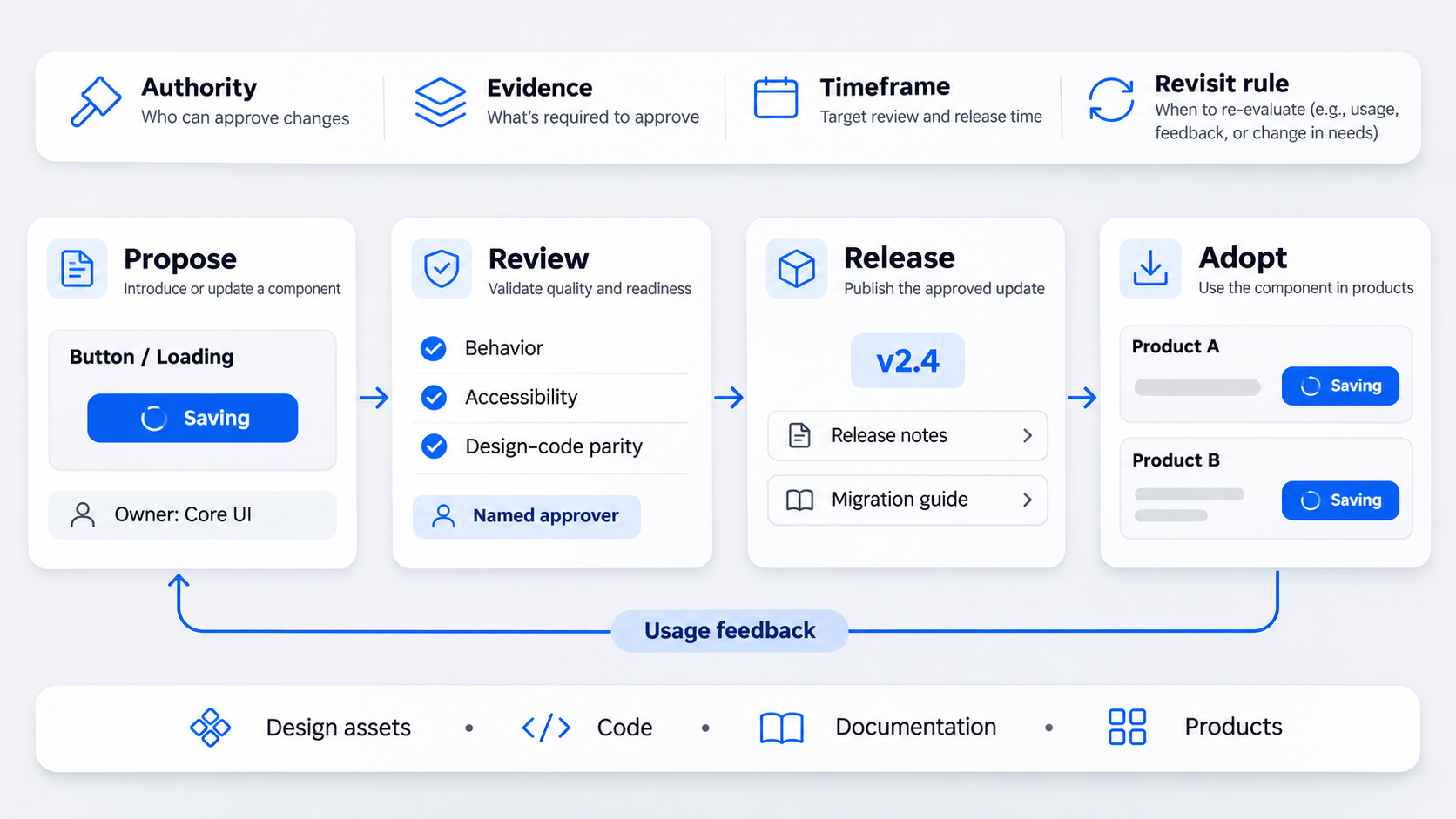 Design system governance is the operating model for changing, releasing, and maintaining a shared design system. It is not simply a committee, style guide, or permission to edit a Figma library.
Nielsen Norman Group describes a design system as a set of standards for managing design at scale, reducing redundancy, and creating a shared visual language. Governance makes those standards dependable by preserving the relationship among design assets, production code, documentation, release processes, and consuming products.
That relationship covers more than appearance. A visually consistent component can still fail the system’s standards when its keyboard behavior, accessibility, content rules, responsive states, analytics, or coded implementation differ.
Building a design system establishes principles, tokens, components, and patterns. Governance determines how those assets evolve and who is accountable for the result.
Governance is a decision system, not a meeting
A healthy governance model answers four questions:
- Who has final decision authority?
- What evidence does the decision require?
- How quickly should the decision happen?
- When and how can it be revisited?
Consultation can be broad, but approval must be clear. If every component decision requires consensus, decision authority has not been properly assigned.
The outcomes governance should protect
We expect governance to support:
- Reliable reuse across products and platforms
- Accessible, predictable behavior
- Controlled flexibility for legitimate product needs
- Maintainable design and code implementations
- Coordinated releases and migrations
- Transparent, time-limited exceptions
The practical outcome is trust. Teams should know that an approved asset will not create hidden engineering work before release.
Choose among four design system governance models
Our framework uses four design system governance models: centralized, federated, hybrid, and distributed. The right choice depends on product complexity, platform coverage, compliance exposure, contribution volume, maintainer capacity, and system maturity.
| Model | Ownership | Main advantage | Main risk |
|---|---|---|---|
| Centralized | One system team | Strong consistency | Slow decisions and ticket queues |
| Federated | System and product representatives | Domain expertise | Ambiguous authority |
| Hybrid | Central core with delegated domains | Balance of control and speed | Poorly defined boundaries |
| Distributed | Autonomous teams using shared contracts | Local speed | Incompatible forks |
Federation does not automatically improve scale. Without bounded authority, shared acceptance criteria, and escalation rules, it can distribute inconsistency instead.
Centralized and federated governance
Centralized governance suits organizations where coherence, regulation, or brand control outweighs local autonomy. It becomes a bottleneck when one small team reviews documentation fixes, domain patterns, core architecture, and breaking changes with equal intensity.
Federated governance brings product expertise into the system. It works best when domain owners are trained, understand what they may approve, and have a published route for escalating core, accessibility, or cross-product decisions.
Hybrid and distributed governance
Hybrid governance centralizes tokens, core components, accessibility requirements, and release contracts while delegating bounded domain decisions. We often recommend it when organizations need both shared control and local expertise, provided the boundaries are explicit.
Distributed governance gives teams greater autonomy. It needs strong compatibility contracts, versioning, telemetry, and implementation standards. Without them, shared components can become incompatible local forks.
A model-selection scorecard
Assess each model against:
- Compliance and accessibility risk
- Number of products, brands, and platforms
- Release frequency
- Cross-brand variation
- Maintainer capacity
- Expected proposal volume
- Cost of incompatible implementations
Reassess the model as adoption and organizational needs change. Governance should evolve with the system rather than harden around an outdated team structure.
Assign roles and final decision rights
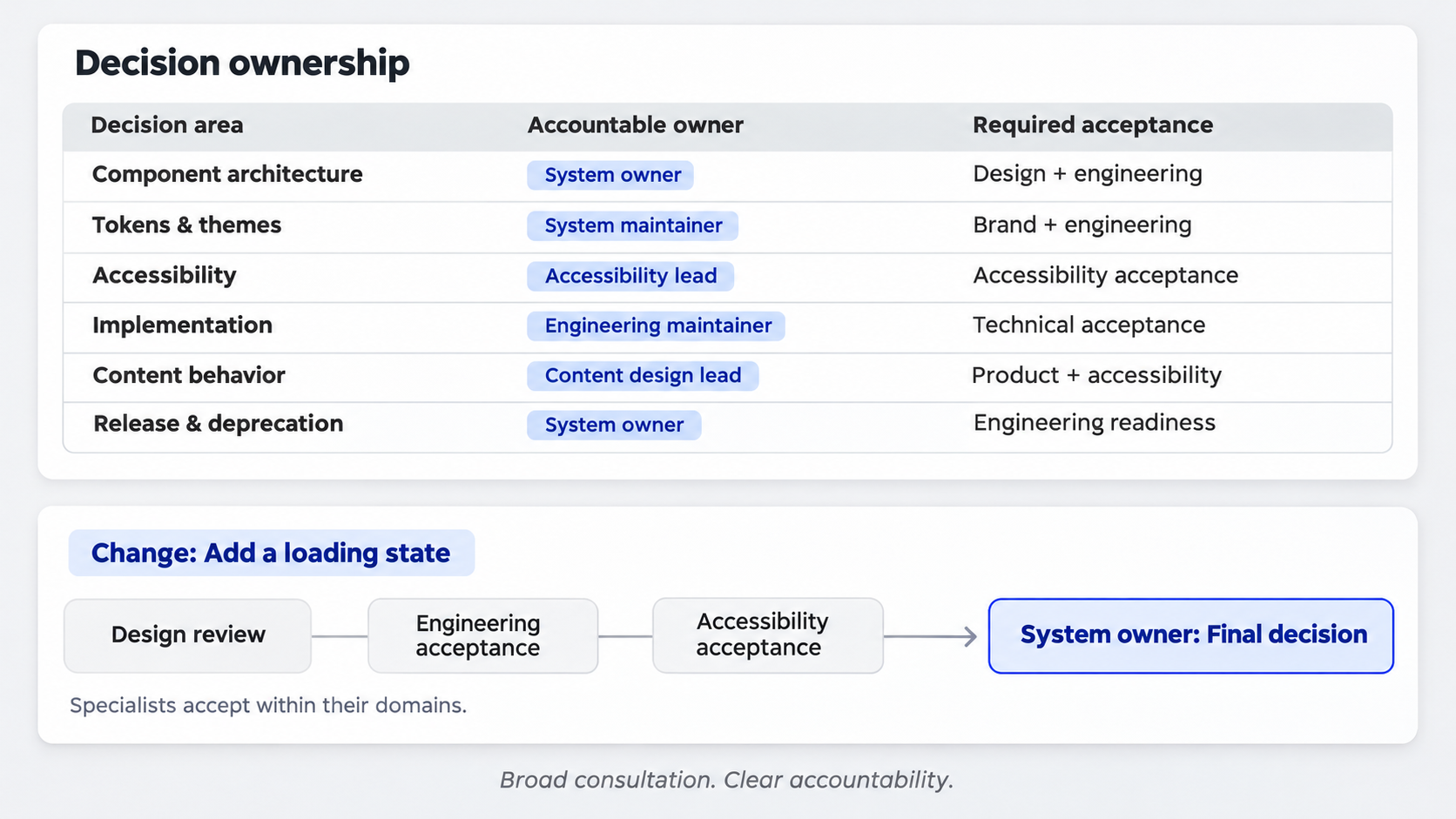 Governance roles may include an owner, maintainers, contributors, specialist reviewers, approvers, and informed stakeholders. Not every role needs veto power.
We recommend using RACI for recurring responsibilities and DACI for discrete decisions. Publish the matrix beside the contribution workflow so teams do not have to discover authority through meetings.
A practical RACI or DACI matrix
A compact decision matrix might assign:
| Decision area | Accountable owner | Required acceptance |
|---|---|---|
| Component architecture | Design system owner | Design and engineering |
| Tokens and themes | System maintainer | Brand and engineering |
| Accessibility | Accessibility lead | Accessibility acceptance |
| Implementation | Engineering maintainer | Technical acceptance |
| Content behavior | Content design lead | Product and accessibility input |
| Release and deprecation | System owner | Engineering readiness |
Accessibility and engineering need explicit acceptance authority within their domains. One named owner should still make the final decision for the overall change.
Delegate without losing control
Domain owners can approve changes within documented architecture, quality criteria, and package boundaries. A commerce maintainer, for example, might approve a bounded checkout pattern without controlling global token architecture.
Escalation is appropriate when a change affects the shared core, breaks existing behavior, alters cross-product contracts, or introduces material accessibility, security, brand, or regulatory risk.
Run a contribution workflow teams will use
A practical contribution process moves visibly through proposal, evidence, design review, technical review, accessibility review, approval, release, and adoption. The evidence required should be proportional to the risk.
Relevant evidence can include user need, likely reuse, state coverage, technical feasibility, accessibility, lifecycle cost, and migration impact. We recommend publishing review expectations so the official route can compete with local workarounds.
From proposal to approval
Start with a short contribution brief containing:
- The problem and affected users
- The current workaround
- Expected reuse
- Alternatives considered
- Known technical or accessibility constraints
- One accountable owner
Use asynchronous written review by default. Meetings should resolve meaningful trade-offs, not repeat comments already captured in the decision record.
Tier reviews by risk
Fast-track documentation corrections, examples, and nonbreaking token aliases through maintainer approval. Require cross-functional review for new interactions, breaking token changes, accessibility-sensitive patterns, or changes affecting multiple products.
Risk tiers stop minor corrections from waiting behind architectural decisions and direct specialist attention toward changes with lasting consequences.
Release and adoption are governance stages
Design approval is not completion. A governed release includes code, documentation, migration guidance, release notes, version references, and named support ownership.
Track whether teams adopt, override, detach, fork, or avoid the release. Avoidance may expose a missing state, weak implementation, slow support, or a pattern that does not belong in the shared core.
Decide: component, variant, token, pattern, or exception?
We use a repeatable decision tree:
- Does the need have a distinct semantic purpose?
- Is there evidence of reuse beyond one surface?
- Does behavior change, or only presentation?
- Can the existing architecture support it safely?
- What accessibility and maintenance obligations follow?
- Where should it live throughout its lifecycle?
Place the result in the appropriate layer: core system, theme, domain package, product extension, experiment, or exception register. Strong Figma design system examples can show how established libraries separate foundations, components, variants, and documentation.
Not every repeated pattern belongs in the core. Limited duplication may cost less than forcing every consuming team to support permanent shared complexity.
Approval criteria for shared additions
Create a component when a reusable semantic and behavioral contract exists across contexts. Use a variant when the purpose remains stable but a supported size, density, state, or emphasis changes.
Use a token for a reusable design value rather than component logic. Choose a domain pattern when the need is repeatable but specific to one product area.
Example: compact data-table rows
Test a compact-row request for readability, pointer and touch targets, keyboard navigation, responsive behavior, content density, and demand across products. Maintainers should also assess accessibility and localization constraints.
Approve a density variant only when the system can support and maintain it. Otherwise, record a product-specific, time-limited exception with an owner and migration plan.
Control exceptions without banning them
An exception should record:
- Rationale and affected product
- Known risks and affected surfaces
- Accountable owner
- Expiration date
- Review trigger
- Migration plan
Review aging exceptions and recurring requests. Repetition may reveal an emerging shared need or confirm a persistent domain constraint.
Make design-to-code parity a release gate
Figma approval is one checkpoint. Production code must match approved states, tokens, content rules, responsiveness, interaction behavior, and accessibility requirements.
Create versioned links among design components, code packages, documentation, and release notes. Teams exploring an AI-to-Figma conversion workflow should apply the same traceability before generated designs enter implementation.
A concise parity checklist
Before release, verify:
- Linked design and code versions
- Documented states and token mappings
- Responsive behavior
- Long content and localization
- Loading, empty, success, and error states
- Keyboard and assistive-technology behavior
- Analytics hooks
- Visual regression results
- A named owner for discrepancies
Automation can identify drift, but it does not replace accountable review.
Prevent local overrides from becoming forks
Record why teams override or duplicate components. Route recurring gaps into the contribution workflow instead of treating them as isolated mistakes.
Breaking changes need compatibility guidance, deprecation notices, and migration timelines. Consuming teams should not discover a governance decision through a failed build or production regression.
Own quality after handoff
Design-system designers and engineers should jointly own implementation quality. Define accessibility acceptance criteria before approval rather than adding them after development.
Validate components in representative product contexts before marking them stable. A component that works in a library sandbox may fail with real content, navigation, data, or responsive constraints.
Scale governance without creating a ticket queue
Enterprise design system governance scales through domain ownership, review expectations, asynchronous records, office hours, self-service criteria, and explicit escalation paths.
The system team is a service provider as well as a gatekeeper. We do not recommend mandating adoption until maintainers can provide dependable review, release, support, and migration processes.
The minimum governance artifacts
Maintain:
- A contribution brief
- A searchable decision log
- Lifecycle labels such as proposed, experimental, stable, and deprecated
- A changelog and deprecation notices
- An exception register
- Published escalation paths
Keep templates where teams already work, but maintain one authoritative record. Multiple undocumented spreadsheets create another governance problem.
Measure governance outcomes, not library activity
Measure contribution cycle time, review performance, adoption, overrides, detached instances, forks, exception age, production parity, accessibility defects, and migration completion.
Library enablement, downloads, or component insertions do not prove compliant adoption. A team can insert an approved component and then detach or override it before release.
Create feedback loops
Use office hours for discovery and coaching, not as the only route to approval. Decisions should remain accessible to contributors who cannot attend.
Combine product telemetry, repository evidence, support themes, and representative audits. This helps prevent the loudest requester from defining the system roadmap.
Govern AI-generated UI as a proposal
AI-generated UI can accelerate exploration and specification, but it does not grant approval or create a parallel source of truth. Our practical UXMagic workflow is to describe, design and ship a concept, map it to governed primitives, flag unsupported choices, and submit genuine additions for review.
Our guide to creating AI interfaces that are actually shippable follows the same principle: visual polish is not proof of technical, behavioral, or accessibility compliance. Accountable people remain responsible for shared standards and lifecycle costs.
Example: an AI-generated onboarding form
Compare generated field spacing, validation states, button hierarchy, content rules, focus order, error recovery, and responsive behavior with the approved system.
Replace near-match values with governed components and tokens. Classify unresolved needs as a proposed variant, domain pattern, experiment, or time-limited exception rather than letting a generated screen become accidental precedent.
Assess AI design tools for governance fit
We assess whether an AI UI design generator can:
- Use existing system inputs
- Preserve semantic editability
- Expose component and token mappings
- Support accessibility review
- Produce usable exports
- Record provenance and versions
- Fit existing approval workflows
- Avoid unnecessary proprietary lock-in
Enterprises should also assess AI generator security, privacy, governance, and scalability. Generation speed matters, but control, portability, consistency, and reviewability determine governance fit.
Use this design system governance framework
A useful framework defines scope, model, roles, decision classes, evidence, workflow, review expectations, release gates, exceptions, metrics, and review cadence. It should evolve alongside product architecture, compliance demands, system maturity, and observed friction.
One-page governance template
Document:
- System scope and architectural layers
- Governance model
- Named decision owners
- RACI or DACI assignments
- Change and risk tiers
- Required evidence
- Review stages and target response times
- Design-to-code parity requirements
- Release authority
- Exception and escalation fields
- Deprecation rules
- Outcome metrics
Each field should connect to an operating decision rather than exist as unused documentation.
30-day rollout plan
- Week 1: Audit current decisions, bottlenecks, forks, parity gaps, and undocumented exceptions.
- Week 2: Assign decision rights, define system layers, and classify change risk.
- Week 3: Pilot the workflow with one real proposal.
- Week 4: Publish review expectations, examine cycle time, gather feedback, and revise unclear criteria.
A focused pilot usually exposes practical gaps more clearly than debating an ideal process in the abstract.
Questions the framework should answer immediately
Contributors should be able to determine:
- Who has final say?
- What evidence earns approval?
- When can they expect a response?
- Which decisions can be delegated?
- When is escalation required?
- How are exceptions reviewed and retired?
- How will design, code, documentation, and shipped behavior stay aligned?
If the framework cannot answer these questions quickly, it is documentation rather than governance.
Describe, design and ship within governed guardrails
Use the UXMagic AI UI generator to turn product requirements into editable, Figma-ready interface proposals, then map the output to approved components, validate parity, and route genuine system changes through accountable review.