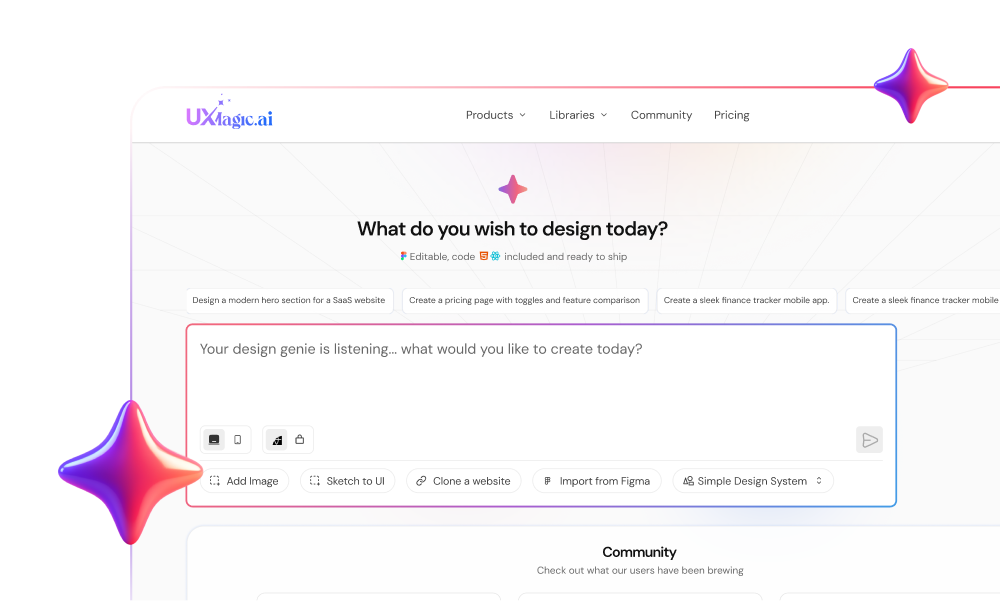
You generated a “beautiful” dashboard in 20 seconds.
And then engineering asked:
“What happens when the API fails?”
Silence.
This is the new design crisis. We can generate polished screens instantly. But most of them are what I call Zombie Designs : they look alive, but there’s no logic underneath.
In the AI era, prompting for screens is lazy. Prompting for flows is leverage.
If you’re a founder or designer building real products, not Dribbble shots. This shift is non-negotiable.
The Crisis of Static Screens
For 20 years, the “unit of value” in UX has been the screen.
Now AI can generate those screens in seconds.
The problem?
AI is biased toward the Happy Path.
Ask for a checkout page and you’ll get:
- Full cart
- Logged-in user
- No errors
- No latency
- No edge cases
It looks finished. It’s not.
The Logic Gap
When you skip structural thinking and jump to visuals:
- Engineers guess missing states
- Error handling becomes inconsistent
- UX degrades outside the “perfect” scenario
That gap is** Design Debt.**
The screen promises logic the system doesn’t actually have.
From Spatial Design to Temporal Design
Traditional UX = Spatial design Arranging pixels on a screen.
AI UX requires Temporal design. Orchestrating intent over time.
A flow is not a sequence of screens.
It’s:
- A logic tree
- A state machine
- A set of transitions triggered by events
Stop asking AI to “paint.” Start asking it to “think.”
If you’re exploring how AI changes UX workflows more broadly, this shift builds directly on the ideas in our piece on prompting UI that actually ships.
The Psychology Behind Flow-First Prompting
AI is not visual-first. It’s linguistic and pattern-driven.
That’s why prompting for intent works better than prompting for screens.
Jakob’s Law: Use Familiarity Intelligently
Users expect:
- Profile in top-right
- Standard checkout patterns
- Predictable navigation
When prompting:
- Explicitly say where to follow convention
- Explicitly say where to innovate
Example:
“Use a standard SaaS top navigation (Jakob’s Law), but introduce an AI-agent interaction in the bottom-right for contextual help.”
Without that instruction, AI hallucinates novelty where it shouldn’t.
Intent-Driven Architecture (IDA)
Old model:
Menu → Settings → Privacy → Password
New model:
User says: “Change my password” System serves recovery flow.
Screen-based prompt:
“Create a settings page.”
Flow-based prompt:
“Design a recovery flow triggered by user intent to secure their account. Include identity verification before credential update.”
AI understands semantic intent better than visual layout.
Use that.
Think in States, Not Screens
Every feature is a state machine:
- Idle
- Loading
- Success
- Error
- Empty
Most AI prompts generate only the Success state.
That’s amateur.
Advanced Prompt Engineering for User Flows
Generic prompts = generic outputs.
Here’s what actually works.
The REFINE Framework
Use this when designing serious flows.
R — Role
“Act as a Senior Product Designer specializing in logic.”
E — Expectation
“Produce a Markdown table outlining step-by-step logic.”
F — Format
List? Table? Mermaid diagram?
I — Iterate
“After generating the happy path, critique and add 3 edge cases.”
N — Nuance
“User is stressed. Minimize cognitive load.”
E — Example
Reference an existing flow pattern.
This forces structural thinking.
The CARE Framework
Especially powerful for business-critical flows.
- Context
- Ask
- Rules
- Examples
The magic is in Rules.
Without rules, AI defaults to the simplest path.
Example rules:
- “User cannot proceed without email verification.”
- “Checkout must happen on a single page.”
- “Password must be 12 characters.”
Hard constraints produce usable flows.
Chain-of-Thought Prompting
Instead of: “Create a signup flow.”
Try:
- Identify regulatory requirements.
- Analyze friction points.
- Determine minimum data required.
- Then outline the flow.
You’re forcing the AI to reason before designing.
The output quality jumps.
Edge Case Prompting (Kill the Happy Path)
Do this every time:
- Generate happy path.
- Ask: “Identify 5 ways this fails.”
- Update flow to handle those failures.
Assign the AI a QA persona.
Red-team your own UX.
High-Leverage Keywords
Use semantic triggers like:
- Progressive Disclosure
- Cognitive Load
- State Management
- Information Architecture
- User Intent
“Screen” triggers visuals. “Flow” triggers logic.
Choose wisely.
The Tooling Landscape: Which AI Tools Handle Logic?
Not all AI design tools are built for flows.
Here’s the honest breakdown.
UXMagic: Logic-First for SaaS
UXMagic is built around logic-heavy SaaS workflows.
Key strengths:
- Flow Mode (Beta) : generates connected flows, not isolated artboards
- Reference Frame Consistency : prevents visual drift across screens
- Agentic Editing : change navigation structure without breaking layout
For complex dashboards and B2B flows, this matters.
If you’ve ever struggled with inconsistent UI between screens, the consistency system directly addresses that problem.
Relume: Architecture First
Relume forces you to generate a sitemap first.
You cannot skip structure.
Best for:
- Marketing sites
- Content-heavy platforms
- Navigation validation
Strong architecture enforcement.
Galileo AI: Visual Exploration
Fast. Beautiful. Aesthetic-first.
But multi-step logic often needs manual stitching.
Best for:
- Consumer apps
- Mobile MVPs
- Visual exploration
v0 & Lovable: Code Is the Flow
These tools generate production-ready React.
You don’t get a picture of validation logic.
You get the logic.
Best for:
- Functional prototypes
- Developer-designers
- Rapid MVPs
This is where design and engineering merge.
Deconstructing Real SaaS Flows
Let’s make this concrete.
Onboarding: First 30 Seconds
Requirements:
- Branching logic
- Personalization
- Max 3 steps to value
- State persistence
Prompt like this:
“Design a setup wizard with branching. If user selects ‘Developer,’ route to API key generation. If ‘Marketer,’ route to template selection. Save progress if user drops off at step 2.”
That’s flow logic. Not a welcome screen.
Checkout: Trust + Error Prevention
Prompt specifics:
- Auto-detect card type
- Disable Pay until valid
- Specific validation messages
- Loading state with secure animation
Explicit error logic creates trust.
Vague prompts create generic alerts.
Search: Intent Matching
Design for:
- Idle state (Recent, Suggested)
- Type-ahead suggestions
- Noun vs Verb differentiation
- No-results recovery
Example:
“If user selects ‘Invite User,’ open modal without leaving page.”
That’s context preservation.
State-Based Design and Design Debt
Every app is a state machine.
Example variables:
- isUserLoggedIn
- cartItemCount
- apiStatus: Idle | Loading | Success | Error
When you design only the Success state, you leave 95% undefined.
That’s Design Debt.
Engineers then:
- Add generic browser alerts
- Patch edge cases inconsistently
- Break the premium illusion
The State Matrix Deliverable
Instead of delivering screens, deliver a State Matrix.
Example: File Upload
- Initial
- Hover
- Uploading (Progress %)
- Processing
- Success
- Error: Type
- Error: Size
Force AI to generate specs for each.
Now your flow reflects technical reality.
How Teams Should Adapt
This changes handoff.
Old: Figma → Jira → Dev
New:
- Flow logic summary
- Validation rules
- Edge case mapping
- Optional code output
Designers should peer-review flows for logic gaps before development.
This is where Flow Mode in UXMagic becomes useful — not for prettier screens, but for validating transitions and consistency before handoff.
Prompt libraries should be shared across teams.
Consistency in prompts = consistency in product.
The Future: Agentic UX and Vibe Coding
Static settings pages are dying.
Agentic UX means:
- User expresses intent
- Interface dynamically generates the right controls
- Guardrails enforce constraints
Designers won’t just design screens.
They’ll design constraints for agents.
And with code-generating tools, the mockup phase shrinks.
The flow becomes the prototype.
Ready to Stop Designing Zombie Screens?
If your AI outputs look polished but fall apart in edge cases, you’re still prompting for nouns.
Try prompting for verbs.
Start with:
“Design a flow that…”
And if you want to see how logic-first generation works in practice, explore UXMagic’s Flow Mode and build a full state-aware journey instead of another isolated screen.
Because in the AI era:
The pixel is cheap.
The logic is the product.
Generate Complete User Flows with AI
Stop generating random screens. Create connected user flows with real logic, edge cases, and structure your team can actually build.