
TL;DR: Base44 pricing runs from a free plan to Elite at $200 a month, with Starter at $20 ($16 billed annually) as the cheapest paid tier. Every plan gives you two meters: message credits for building and integration credits for running the live app, and neither rolls over. Most of the money goes on iteration, so the cheapest way to use Base44 is to settle the UI first in a design tool like UXMagic, then build. For other options, see our Base44 alternatives.
Base44's pricing page looks simple: five cards, a yearly toggle, and two credit numbers per card. What it can't show is how fast those credits go, because that depends on how you prompt, which model runs, and what your app does once people use it.
This guide covers every Base44 plan as listed in September 2026, how the two credit types work, what a prompt and an integration call typically cost, three cost scenarios, the costs that are easy to miss, and how to spend less. It ends with a comparison against Lovable, Bolt, Replit, v0 and UXMagic.
A note on sources: plan prices and credit allowances come from Base44's pricing page and Base44's own pricing blog post. Credit costs and billing rules come from Base44's documentation on credits and billing and plans. Base44 (now part of Wix) updates its plans often, so treat every figure as "as listed in September 2026".
Base44 pricing at a glance
| Plan | Monthly billing | Annual billing | Message credits | Integration credits | Who it suits |
|---|---|---|---|---|---|
| Free | $0 | $0 | 25 a month (max 5 a day) | 100 a month | Trying Base44, one small app |
| Starter | $20 | $16/mo | 100 a month | 2,000 a month | Personal tools, side projects |
| Builder | $50 | $40/mo | 250 a month | 10,000 a month | MVPs and client-facing apps |
| Pro | $100 | $80/mo | 500 a month | 20,000 a month | Complex apps, small teams |
| Elite | $200 | $160/mo | 1,200 a month | 50,000 a month | Main product or business on Base44 |
| Enterprise | Custom | Custom | Custom | Custom | SSO, security controls, account team |
Two things stand out. First, the yearly discount is a flat 20% on every paid tier, and some perks (a free domain for a year, 25 credits to share with a friend) only come with yearly billing. Second, the jump from Starter to Builder is where the real features are, not just more credits.
Base44 plans in detail
Is Base44 free? The free plan
Yes. The free plan costs nothing and needs no credit card. You get Base44's core features, including the AI builder, authentication, the built-in database and analytics, with these limits:
- 25 message credits a month, capped at 5 a day. The daily cap resets at midnight in the workspace owner's time zone. Once you hit 25 for the month, you wait for the next cycle.
- 100 integration credits a month for things your live app does, such as sending emails or calling an LLM.
- Up to 5 apps.
- No new private apps. Since 6 February 2026, creating a private app needs Starter or above.
- Automatic AI fixes cost credits. On the free plan, "Resolve with AI" and auto-fix messages draw from your message credits. On paid plans they are free.
Five messages a day will scaffold a simple tool, not finish one with a login flow, data models and a polished UI.
Base44 Starter
Starter costs $20 a month, or $16 a month billed annually ($192 a year). It includes 100 message credits and 2,000 integration credits a month, unlimited apps, in-app code edits, connecting your own domain, and removing the Base44 platform badge from your app.
What Starter does not include is just as important: no backend functions, no GitHub integration and no AI model selection. Those start on Builder. Starter suits a personal tool or an internal dashboard that lives happily inside Base44.
Base44 Builder
Builder costs $50 a month, or $40 a month billed annually. It includes 250 message credits and 10,000 integration credits, and adds:
- Backend functions for custom server-side logic.
- GitHub integration. Base44 describes it as two-way sync that exports the full source code to your own repo.
- AI model selection, so you can pick a model instead of Automatic routing.
- A free domain for one year and 25 credits to share, on yearly billing only.
Base44 labels Builder its popular plan, and for anyone shipping to real users it is the first tier that makes sense.
Base44 Pro
Pro costs $100 a month, or $80 billed annually, with 500 message credits and 20,000 integration credits. The only feature it adds over Builder is early access to beta features. You are mainly paying for double the credits.
Base44 Elite
Elite costs $200 a month, or $160 billed annually, with 1,200 message credits and 50,000 integration credits, plus premium support. Base44's docs note that on the plans page you can use a drop-down on Elite to choose a larger amount of credits. Elite is the highest plan you can buy directly. Past it, you talk to sales.
Base44 Enterprise
Enterprise is custom-priced and adds custom credits, a dedicated architect, SSO, advanced security controls and an account team.
Academic discount and other offers
Students, teachers and staff at accredited schools and universities get 50% off Starter or Builder after verifying a school email. On monthly billing it lasts up to 12 months, on annual billing the first year, and it can be claimed once per account.
How Base44 credits work
Message credits vs integration credits
Base44 splits usage into two meters, and it is worth understanding both before you pick a plan.
- Message credits pay for building. Every prompt that plans, adds, changes or fixes part of your app uses them.
- Integration credits pay for running. They are used when your live app calls one of Base44's built-in services: sending an email, uploading a file, generating an image, running an LLM call, sending a message to an in-app agent, or running a workflow step.
The split separates what building costs from what your users cost, and it means your app keeps using credits after you stop building. Database reads and writes are free, and so is calling an external service with your own API key.
How much does a Base44 prompt cost?
Base44 does not charge a fixed amount per message. Credits are calculated after each request runs, based on how much work the builder did. Its docs give these rough ranges:
| Scope of change | Typical message credits |
|---|---|
| Simple visual or text change | About 0.5 |
| Improving a small feature | About 1 |
| Adding a complex module | About 2 |
| Large or app-wide change | About 3 to 4 |
| Discuss mode message | About 0.3 |
| Manual visual edit in the editor | 0 |
These are estimates: costs vary with the model, and a short prompt like "translate the whole app" can still be expensive because it touches many files. Credits Used in the message menu shows what a prompt actually cost.
How much do integrations cost?
Integration costs are more predictable. According to Base44's docs:
| Integration | Typical integration credits |
|---|---|
| Send an email | About 1 (about 2 from a custom domain) |
| Upload a file or extract data from it | About 1 |
| Generate an image | About 1 |
| Generate video | About 5 per second |
| LLM call on Automatic | About 1 |
| LLM call on a premium model | About 5 to 15 |
| In-app agent message on Automatic | From about 3 |
| Workflow steps | About 1 per 10 steps |
| Backend function invocations | About 1 per 100 |
The model choice matters most. An LLM feature that runs on Automatic costs about 1 credit per call; switch it to a top model and the same feature can cost 15 times as much.
Do Base44 credits roll over?
No. Paid-plan credits reset on the same day each month that you subscribed, and unused message and integration credits expire. Free-plan credits run on a daily cap within a monthly total. Referral credits are separate one-off bonuses that expire 40 days after you earn them.
Can you buy more Base44 credits?
Not in the pay-as-you-go way that Lovable or Replit sell top-ups. Base44's pricing page lists no credit packs, and its docs say that when you run out you wait for your reset date or upgrade. Upgrades take effect immediately with new credits available, and you can downgrade at the end of the cycle.
There are free ways to add credits:
- Referrals. A friend who signs up with your link gets 30 credits; you get 30 when they publish an app and 100 if they upgrade.
- Sharing your project on LinkedIn or X, tagged @base44, for 20 message credits, once per account.
- Promo codes and coupons, redeemed under Credit usage in settings.
Decide the design before you spend build credits
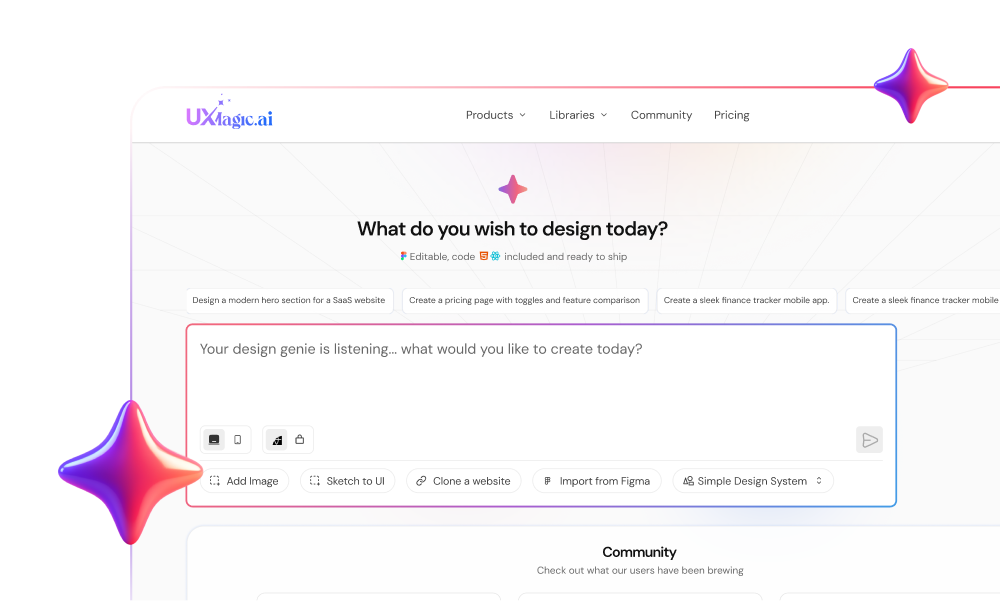
Plan and design every screen of your app for free in UXMagic, then hand Base44 a finished visual target and precise prompts.
Real Base44 cost scenarios
Base44 publishes cost ranges, not a price list, so these scenarios use its estimates to show where credits go rather than to promise a bill.
Scenario 1: a solo founder building an MVP
You want a small SaaS MVP: landing page, sign-up, onboarding, a dashboard with two or three data models, settings, and email notifications. Using Base44's ranges, the first build of each area is a complex module at about 2 credits, the auth and data wiring maybe 3 to 4, and then come the fixes and tweaks at 0.5 to 1 each.
A realistic first version is 60 to 120 message credits once you count iteration. That is more than Starter's 100 in a heavy month, and the free plan's 25 won't get you past the dashboard. Add a custom domain and GitHub sync and you are on Builder: $40 a month on annual billing, or $50 monthly. Our breakdown of what a SaaS MVP costs to build with AI puts these numbers next to agency and freelancer quotes, and the AI MVP builder page covers planning the screens first.
Scenario 2: iterating on the UI
This is where Base44 budgets quietly go. Take a landing page and six app screens, each going through five rounds of visual change: spacing, hierarchy, colours, new sections. That is 35 requests. At the lighter end (0.5 credits each) it is about 18 credits; if half of them touch several screens at once, it is closer to 40. Manual edits in the visual editor are free, which helps for text and small tweaks, but layout rethinks go through the AI.
The same work in UXMagic, using our credit cost table: a screen plan costs 1 credit, seven new screens cost 21, 35 targeted edits cost 7, and theme changes cost 0. That is about 29 credits, which the UXMagic free plan (20 credits a day, up to 3 screens a day) covers in a few days. Base44 then builds a design that is already decided.
Scenario 3: an app with AI features and real users
Now the integration meter matters. Say your app gives each user an AI summary and sends a weekly email. With 500 active users, one summary each a week on Automatic, plus one email each, that is about 2,000 LLM calls and 2,000 emails a month: roughly 4,000 integration credits. Starter's 2,000 runs out halfway through the month; Builder's 10,000 covers it.
Switch the summaries to a premium model at about 15 credits a call and the same feature needs around 30,000 credits a month, which is Elite territory. When integration credits run out, the features that need them fail and your users see a generic error. Pick the cheapest model that does the job, and test the credit cost of each feature before launch.
Hidden costs in Base44 pricing
Base44's pricing page says there are no hidden fees, and on unit prices that is fair. The surprises come from how usage behaves.
- No price before you prompt. You find out what a message cost after it runs, and broad prompts cost more.
- Mistakes still cost credits. Base44's docs say credits are non-refundable for AI mistakes, because each prompt still did work.
- Two meters, two ways to stall. Run out of message credits and you can't build. Run out of integration credits and live features break for users.
- No small top-ups. Running out mid-month means waiting or upgrading a whole tier.
- Yearly plans are non-refundable. Base44's terms make annual fees non-cancellable, and you can't switch an active yearly plan to monthly yourself.
- Monthly billing loses perks. The free domain and share credits are yearly-only.
- Third-party services bill separately. Stripe, email providers and your own AI API keys charge you directly.
- Platform lock-in on lower tiers. GitHub export starts on Builder, and exported apps still use the Base44 SDK, as our Base44 review explains.
None of this is unique to Base44: our Bolt.new review covers the token version and our Lovable review the credit version.
How to spend less on Base44
- Do the UI/UX work in a design tool first
This is the biggest saving. Base44 designs and codes in the same step, so every layout decision is paid for at build prices, and the AI has to guess your visual intent from text. A design tool separates the two: settle what the product looks like while changes are cheap, then ask Base44 to build something already decided.
UXMagic is built for that step. Describe the product and Flow Mode proposes a screen plan you can approve or edit before anything is generated, then designs every screen on one canvas with a shared theme. The flow mode and screen plans guide shows how it works. Fixing the plan costs 1 credit; fixing eight wrong screens afterwards costs far more.
Theme changes are free in UXMagic, so changing your brand colour across twenty screens is one change, not twenty prompts. The themes and style guides guide explains it, and the AI style guide generator sets up a theme from a prompt. To start rough, the AI wireframe generator settles layout first, and image to UI turns a screenshot or sketch into an editable screen. We walk through the full approach in how to design UI with AI, and explain why generating one screen at a time wastes effort in why single-screen AI design is a dead end.
- Hand Base44 a finished design
Once the design is settled, give Base44 a precise target:
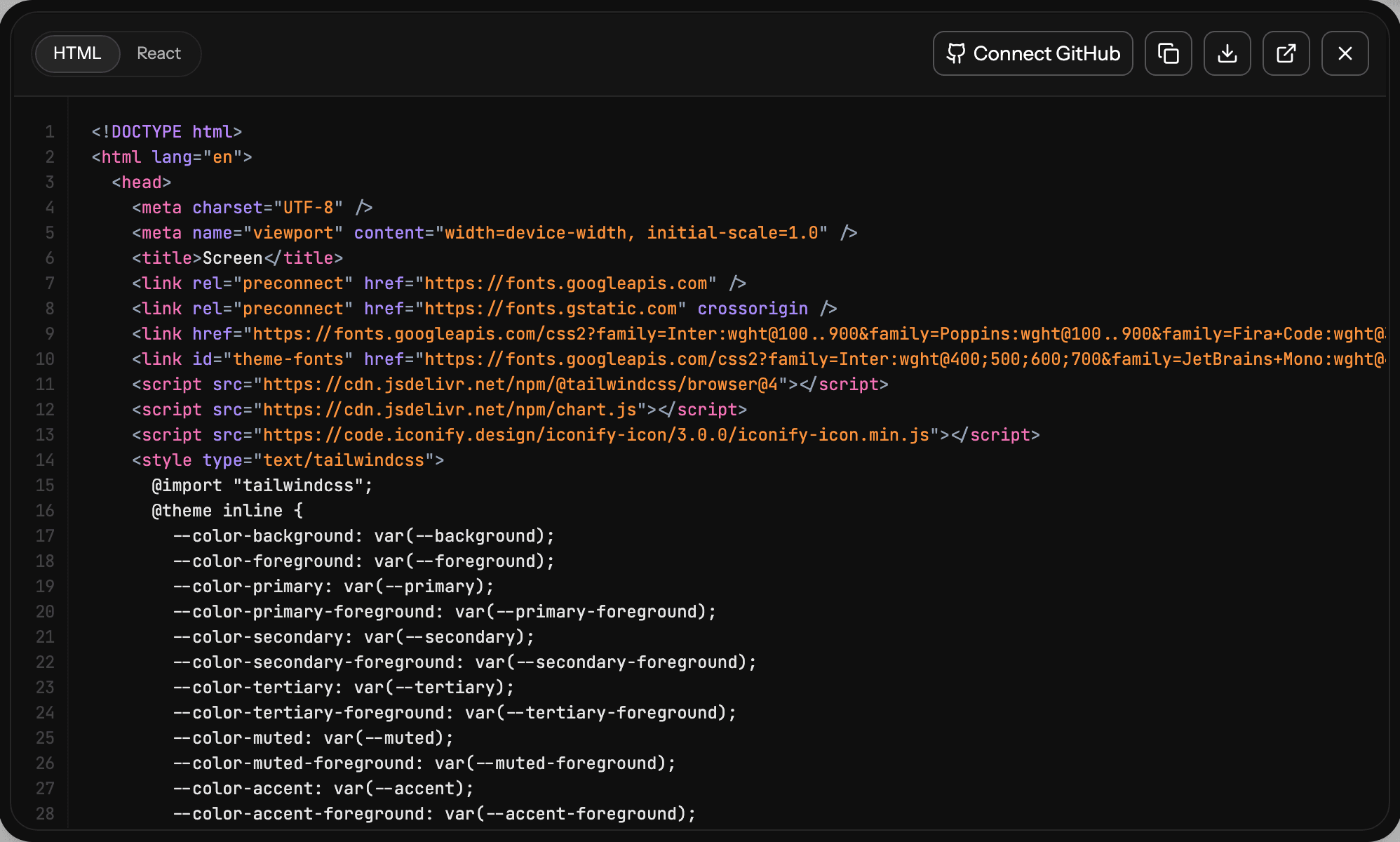
- Export React and Tailwind code with the design to code generator, following the code export guide, and use it as the reference for each page.
- Push the code to a repository with GitHub sync so developers on your team work from the same source.
- Connect the UXMagic MCP server so Claude, Cursor or another coding agent reads the real screens and theme. Reading screens over MCP costs 0 credits.
Base44's job becomes entities, auth, integrations and logic, the split we describe in vibe coding in 2026.
- Prompt the way Base44 bills
- Plan in Discuss mode. At about 0.3 credits a message, it is the cheapest way to think through a feature before Build mode touches files. A short PRD helps too; the AI PRD generator drafts one from a brief.
- Keep prompts narrow. Name the page or function you want changed. Select the element in Edit mode for UI tweaks so the AI doesn't scan the whole layout.
- Revert, don't re-prompt. If a change is wrong, click Revert on that message. After one or two failed auto-fixes, switch to Discuss mode instead of looping.
- Leave the model on Automatic. Base44 says manual model choice is less predictable and can use more credits.
- Use free manual edits for copy, text and small visual changes.
Our guide to prompting for UI that ships applies to app-builder prompts too.
- Watch both meters and pick the right tier
Check Credit usage in settings, which breaks down message and integration credits per app and per day, and review the By source view for integration costs. If you are shipping to users, budget integration credits per feature before launch. And buy yearly only once you are sure: it saves 20%, but it is non-refundable.
Base44 vs competitors: pricing comparison
Prices below come from each vendor's own pricing page as listed in September 2026. The billing units differ (message credits, credits, tokens, dollars of usage), so compare by what your project needs, not the headline.
| Tool | Free plan | Entry paid plan | Higher tiers | Billing unit |
|---|---|---|---|---|
| Base44 | 25 message credits a month, 5 apps | Starter, $20/mo ($16 annually) | Builder $50, Pro $100, Elite $200 | Message and integration credits |
| Lovable | 5 credits a day, max 30 a month | Pro, $25/mo ($21 annually) | Business $50/mo | Credits |
| Bolt.new | 300K tokens a day, 1M a month | Pro, $25/mo, 10M tokens | Teams $30/member/mo | Tokens |
| Replit | Starter: daily Agent credits, 1 app | Core, $20/mo ($18 annually) | Pro $100/mo | Dollars of usage, effort-based |
| v0 | $5 of credits a month | Plus, $30/user/mo | Business $100/user/mo | Credits |
| UXMagic | 20 credits a day | Pro, $35/mo or $17.50/mo annually | Enterprise custom | Credits (2,400 a month on Pro) |
Base44 vs Lovable pricing
Base44 is cheaper to start and bundles more of the backend, email and AI integrations into the plan, with running costs on a separate meter. Lovable costs more at entry but sells top-up credits, has more generous rollover, and offers GitHub sync on every plan. Our Lovable pricing guide breaks down its credits, and Base44 vs Lovable compares the two beyond price. If Lovable is on your shortlist, see our Lovable alternatives too.
Base44 vs Bolt pricing
Bolt Pro is $25 a month for 10M tokens that roll over. Token use grows with project size, so late edits on a large app cost more, where Base44's per-message ranges stay flatter. Bolt gives you more direct access to code. Our Bolt.new pricing breakdown covers the token model, and Lovable vs Bolt compares the two most common Base44 rivals.
Base44 vs Replit and v0 pricing
Replit Core matches Base44 Starter at $20 a month and adds a full development environment, but bills Agent work by effort, so costs vary more. Our Replit pricing guide has the details. v0 is priced per user and focuses on React front ends rather than full apps, as our v0 review explains. For more options by use case, see our Base44 alternatives, our vibe coding tools comparison, or our guide to AI app builders for non-developers.
Where UXMagic fits
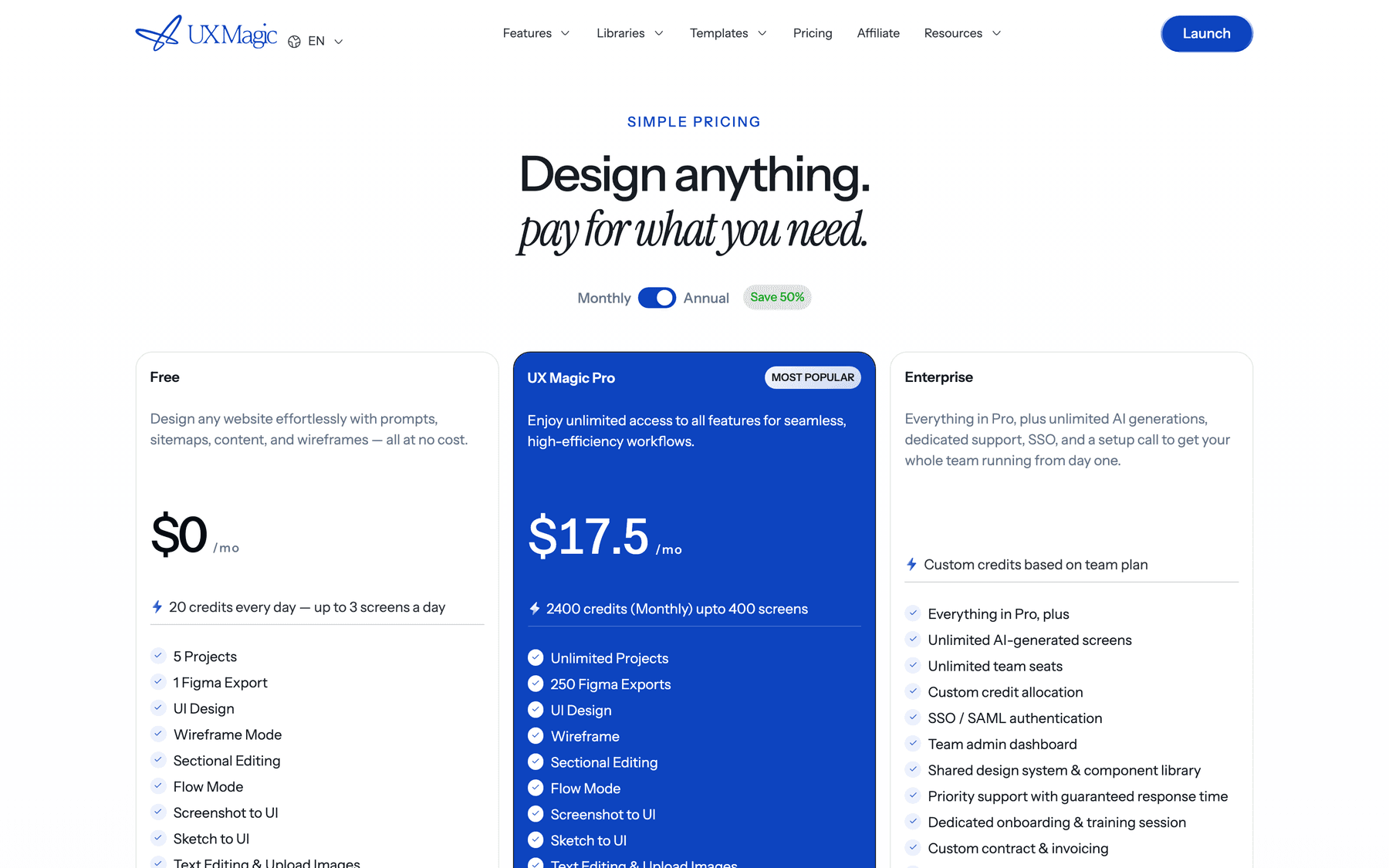
UXMagic is not an app builder and won't host your database or backend. It is the design step before Base44. The free plan gives you 20 credits every day with no card; Pro is $35 a month, or $17.50 a month billed annually, for 2,400 credits (up to 400 screens), unlimited projects and 250 Figma exports. You can also earn free credits through the Unlock Pro Plan steps and referrals. Full details are on our pricing page.
Is Base44 worth the cost?
For non-technical founders who want an app with auth, a database, hosting and integrations without touching infrastructure, yes. Starter at $16 a month on annual billing is one of the cheapest ways into a working full-stack app, and the separate integration meter makes running costs easier to see than on most rivals. For anything client-facing, budget for Builder, since GitHub sync, backend functions and model choice start there.
The cost to watch is not the plan fee. It is iteration: redoing layouts, fixing flows the AI misread, and features built before anyone decided what they should look like. Base44 is priced well for building and badly for deciding what to build, and with no top-ups, a heavy design month forces an upgrade.
So our recommendation is a split workflow. Design the product in UXMagic, where a new screen costs 3 credits, an edit costs 0.2 and the theme is free. Then take that design into Base44 and spend your message credits on data, auth and logic. The UXMagic AI app builder page shows how the design step works, what vibe coding is explains why it matters, and our UXMagic vs Base44 comparison sets the two tools side by side.
Related guides
- 10 Best a0.dev Alternatives for Building Mobile Apps with AI (2026)
- 10 Best Magic Patterns Alternatives in 2026, Grouped by Workflow
- Figma Pricing 2026: Seats, AI Credits, Make and What Teams Really Pay
- 9 Best UX Pilot Alternatives in 2026, Grouped by Use Case
- 9 Best MagicPath Alternatives in 2026, Grouped by How You Work
- 9 Best Uizard Alternatives in 2026, Grouped by Use Case
- 10 Best Figma Make Alternatives in 2026, Grouped by Use Case
- Miro Pricing 2026: Plans, AI Credits and What Free Can't Do
- 15 Best UX/UI Design Tools for 2026, Plus a Startup Stack
- Google Stitch Pricing 2026: Is It Free, and What Are the Limits?
Design it in UXMagic, build it in Base44
Plan and design a connected multi-screen flow for free, then export React code or connect your coding agent over MCP.